How to care for potted osmanthus? These methods are very practical
A potted flowering plant with excellent growth and ornamental condition cannot do without the owner's careful daily care and management. Many potted flowering plants show poor growth due to neglect of management, and their ornamental value naturally decreases to varying degrees. It can be seen that care and management work is the foundation for ensuring the plant maintains good growth and the potted plant keeps good ornamental value. So, how do you care for potted osmanthus?
Potted osmanthus generally grows better outdoors than indoors, because when the pot is placed outdoors, there is often more sufficient light, better ventilation conditions, and with sufficient water and fertilizer, the plant usually grows relatively well. Many gardening friends like to place potted osmanthus indoors for care, and after a long time, phenomena such as dry tips, yellow leaves, and leaf drop appear, and it may even become infected with leaf spot disease, leaf blight and other diseases.
The above many adverse conditions in the plant are mainly due to poor indoor ventilation, plus insufficient light, excessive watering and other factors, which often cause the plant to suffer invasions of some diseases and also make the root system more prone to damage. Therefore, if you want to grow potted osmanthus well, you must provide it with a place with good ventilation and sufficient light, and at the same time do a good job in water and fertilizer management.
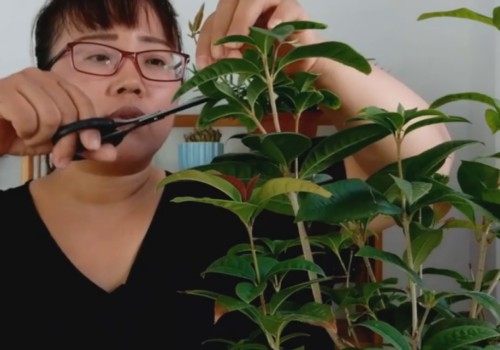
And now autumn has already arrived, and the flowering period of osmanthus will come along with it. The flowering period of osmanthus is usually from September to October, and at the same time osmanthus will gradually sprout new shoots, so at this time we need to do pruning work in time. Remove the apical growth advantage of osmanthus and promote the aging of new branches, so as to promote flower bud differentiation and then flowering. This is because osmanthus flowers on old branches, and new branches and tender branches basically do not flower, or flower very little.
By timely cutting off the terminal buds of potted osmanthus, the plant is prompted to produce side buds, and with the further maturity and aging of the branches, the amount of flowering will naturally increase quite a bit. The pruning at this time is mainly to cut off the tender buds of new branches so that they lose their apical growth advantage, but do not carry out heavy pruning on a large scale, after all, the plant next needs to bloom successfully in large numbers.
In addition, because osmanthus relatively likes fertilizer, during its growth period it needs to be supplemented with some multi-element fertilizer. It is best to apply organic fertilizers such as farmyard manure and cake fertilizer water, generally applying 1-2 times a month of dilute fertilizer water. Be sure not to use the wrong fertilizer; at this time, the main focus is usually on applying phosphorus and potassium fertilizer to the plant. Monopotassium phosphate is a good phosphorus and potassium fertilizer, and it is enough to apply it once about every 10 days.
By scientifically applying additional fertilizer to potted osmanthus, the plant will differentiate a large number of flower buds in about 1 month. Usually, it is enough to dilute with water at a ratio of 1:1000. That is to say, we can take a small spoon of fertilizer, then add it to an amount of water equal to the capacity of a mineral water bottle, and after shaking it well, water the osmanthus with it.
At the same time, combined with good ventilation conditions, sufficient light, suitable temperature, and reasonable watering, after about one month, potted osmanthus can successfully bloom in large numbers, and in the autumn wind we can deeply experience the effect of a sweet fragrance rushing to the nose.