How to care for Daphne odora after it finishes blooming? Master these management points
Daphne odora is both beautiful and fragrant when in bloom, and it is also fairly shade-tolerant, preferring a growing environment with partial shade and plenty of scattered light, so it is very suitable as a household potted plant grown indoors. The only issue is that its fragrance is very strong, and to keep people from feeling uncomfortable, the environment must have smooth ventilation, which makes the floral scent indoors smell even more refreshing.
However, after we finish enjoying the flowers, we also need to promptly strengthen the care and management of the potted Daphne odora. This is because Daphne odora consumes quite a lot of nutrients and energy during the flowering period, and after the flowers fade the plant becomes rather weak, so we need to promptly strengthen management to help it return to normal growth. Otherwise, the potted plant will not only look unattractive, but will also waste unnecessary nutrients for nothing, making the plant grow weaker and making it difficult to recover to its original state. So, how should Daphne odora be cared for after it finishes blooming?
1. Prune promptly
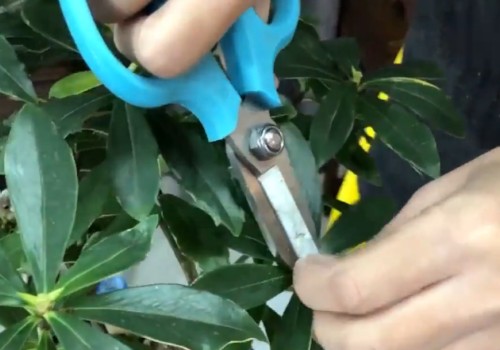
After Daphne odora finishes blooming, be sure to remember to prune it promptly, especially by cutting off the spent flowers, which can prevent the plant from getting pests and also save some nutrients, and it also helps stimulate plant growth to a certain extent. However, pruning of other parts also needs to be decided according to the needs of the plant's shape, keeping the Daphne odora's form as full and rounded as possible.
Of course, in the specific pruning process, you also need to consider the plant's growth condition as appropriate, and properly pinch off the tips of branches that grow tall and long and easily ruin the plant's shape to control their continued growth. But when making the cut, generally count 2-3 leaves from top to bottom, then cut off the tip. After pinching, new buds will sprout from the leaf axils at the tip of the branch. And we also need to cut off the flower receptacle; after a round of pruning, the plant will certainly become more attractive and its growth will also be promoted.
2. Daily care
After Daphne odora finishes blooming, it gradually enters its growth period, so its demand for water and nutrients also increases. At the same time, it also needs more light to promote photosynthesis, so as to speed up sprouting and growth. Therefore, after flowering, care and management in all aspects must be strengthened.
1. Watering
If we do not water it promptly after flowering, the plant may show drooping, sagging leaves. However, once we resume watering, it will regain its vitality. But when watering Daphne odora, note that you should water thoroughly so the potting soil stays slightly moist; the soil should be neither too dry nor too wet, since its fleshy roots are easily damaged by improper watering. Therefore, before watering, be sure to observe the potting soil and the plant's growth condition, and check whether the leaves are drooping, sagging or wilting.
2. Fertilizing
After Daphne odora finishes blooming is when it most needs nutrient replenishment. Generally, we can apply some slow-release compound fertilizer, preferably in granular form, evenly scattered into the pot, which is very convenient, has balanced nitrogen, phosphorus and potassium nutrition, and provides long-lasting fertilizer effect. Of course, you can also apply fertilizer water, but at this time topdressing is usually mainly done by root drenching, and topdressing once every 2 weeks is better.
3. Light
Since Daphne odora ends its flowering period in spring, and spring light intensity is still relatively weak, we should let it get more sun to ensure sufficient light. In this way, the plant can carry out photosynthesis better to form nutrients, recover and grow faster, and naturally grow better. Therefore, providing sufficient light after flowering is also very important for restoring and promoting the plant's growth.
4. Temperature
Spring weather is generally warmer, but occasional "late spring cold snaps" are inevitable, so we still need to pay attention and avoid the plant being frozen by a temporary drop in temperature. Generally, keeping the environmental temperature for Daphne odora's growth stable above 10°C is most suitable, and in spring there is no need to worry about the temperature being too high.