Detailed Explanation of Osmanthus Bonsai Grafting Methods and Operation Steps
Osmanthus has luxuriant branches and leaves, stays evergreen through all four seasons, with gnarled roots and graceful posture, brilliant flowers and rich fragrance. It also has biological characteristics such as strong sprouting ability, tolerance to pruning, and long lifespan, making it an excellent tree species for making tree bonsai. The process of making osmanthus bonsai is complex, learning from nature, and wonderfully exquisite. High-level bonsai benefits from the bonsai masters' profound artistic conception and skilled techniques.
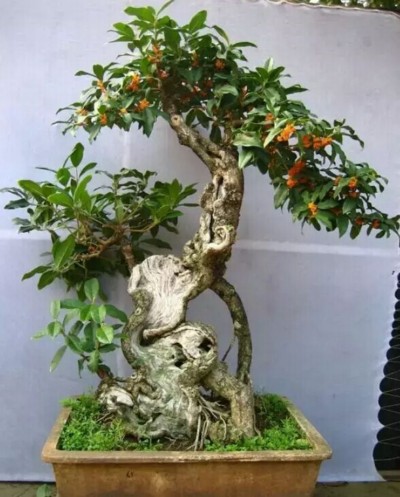
Making medium and large osmanthus bonsai is relatively difficult, but for making small and medium osmanthus bonsai, small-leaf privet (Ligustrum quihoui) or white ash (Fraxinus chinensis) can be used as rootstock. The grafting methods are briefly introduced as follows.
1. Material Selection
When choosing privet as rootstock, select stump material with graceful form, good health, vigorous growth, and suitable for making bonsai. After digging up the stump material, cut off the thick long main roots, retain the fine fibrous roots, and according to the requirements of bonsai making, keep the needed branches and trunks, removing the rest despite the reluctance. Then according to the growth condition of the tree stump, treat the roots, and after growing in the ground for 1-2 years, pot it up as rootstock. Digging should be done in winter or before the sap flows in spring, usually in the first and middle ten days of February.
2. Grafting
For making osmanthus bonsai, grafting is generally adopted, with the approach grafting method and cleft grafting method being the most common. In the Jiangsu region, it can generally be done from March to May, with the best time being before the dog days. Seedlings maintained in the open field are easy to survive and grow vigorously, generally surviving in about two months. The cleft grafting method is generally carried out in mid-to-late March, when small-leaf privet and osmanthus are about to sprout. After cleft grafting, place it in a shaded shed to prevent wind from causing water loss and death. The grafted small-leaf privet stump will sprout new buds and tender leaves, which should be removed entirely as soon as they are found. Afterward, whenever rootstock sprouts or tender leaves appear, they must be removed at any time, strictly preventing the “guest from overpowering the host.” Otherwise, only the rootstock will grow, and the grafted osmanthus branches will not only fail to grow but will wither and die over time. After survival, tip pruning can be done promptly to control height.
Principles for Making Osmanthus Bonsai:
Conception and composition profound; learning from nature genuine; enhancing strengths and avoiding weaknesses to boost vigor; combining movement and stillness with agility; unified and coordinated to please the eye; seeing the big in the small for insight; appropriate density and sparseness; clear primary and secondary for striking effect.