How to Make a Sageretia bonsai: Methods and Steps
Sageretia, also known as duijieci, sageretia vine, sour fruit, and sour-seed tree, is a deciduous climbing shrub of the genus Sageretia in the Rhamnaceae family. The bark is grayish brown, and the slender branchlets bear thorns. The simple leaves are opposite, ovate or elliptical, with finely serrated edges, thinly leathery and bright green. In autumn and winter it produces small pale yellow flowers, and the drupe is nearly spherical, turning purplish black when ripe; it is edible, with a sour taste tinged with sweetness. Its roots and trunk are naturally striking, and its tree form is vigorous and elegantly antique. It is one of the main species for Chinese stump bonsai, one of the five famous trees of Lingnan bonsai, and one of the bonsai plants exported to the United States after China's entry into the WTO.
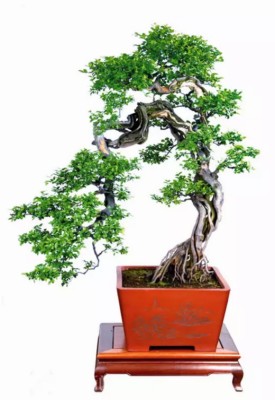
Making a Sageretia Bonsai
1. Obtaining Material
To make a Sageretia bonsai, you can use one-year-old branches for cutting propagation in March or during the plum rain season; you can also carry out layering propagation from April to June; you can also sow seeds as they are collected when the fruit ripens, or dry them in the shade and then sow them in a seedbed to raise seedlings; in the provinces south of the Yangtze River, you can also dig up wild old root stumps or young trees from mountain areas in the wild, and after they survive being planted in the ground to "nurture the rough stock," process them and pot them.
2. Shaping
Sageretia has extremely strong growth vigor, a long lifespan, is easy to shape, has very strong sprouting ability, tolerates pruning, and its small branches are soft and easy to wire. It is mostly processed by the method of coarse wiring and fine pruning; the complete pruning method (that is, the "branch-storing and trunk-cutting method") can also be used for shaping, and processing and shaping can also be carried out mainly by wiring with pruning as a supplement. The tree forms are often made into slanting-trunk style, lying-trunk style, curved-trunk style, deadwood style, double-trunk style, cascade style, exposed-root style, and so on. The leaves are mostly pruned into a natural style, and can also be processed into cloud-pad or steamed-bun shapes.
3. Potting
Transplanting and potting are best done in spring from February to March before budding. Choose a lighter-colored purple clay pot or glazed ceramic pot, and pot shapes such as a relatively shallow or medium-deep rectangular pot or oval pot are preferable. The potting soil should be made by mixing loose, fertile, slightly acidic leaf mold, river mud, and pond mud with sand. When potting, the root system should be properly trimmed, the lateral roots and fibrous roots should be mounded with loose fertile soil, and the bottom of the pot should be lined with tile fragments to facilitate drainage and aeration.