Detailed guide to making a wisteria bonsai, step by step
Wisteria is a large deciduous climbing and twining vine. When wisteria is twined around a flower frame, its branches hang down whenever it blooms, with strings of purple flower clusters suspended among them, creating a romantic and beautiful scene.
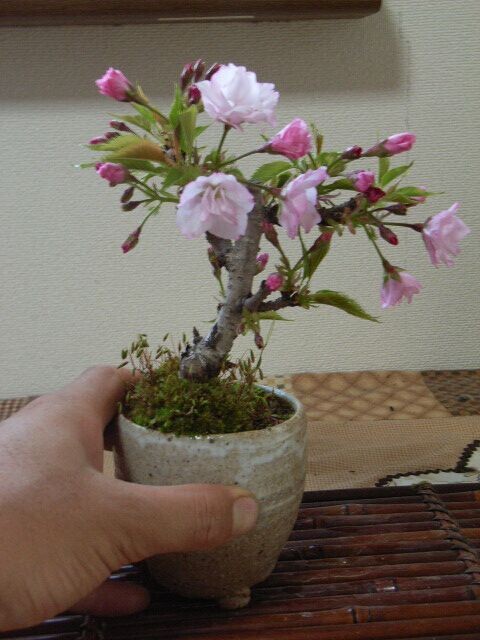
Because wisteria has a very long lifespan and belongs to the long-lived tree species, it is extremely popular for planting among the people. The stems and vines of mature wisteria wind and twist, and it bears abundant flowers. Since ancient times, scholars have loved to use it as a subject for poetry and painting. A wisteria bonsai has a graceful posture; placed on a stand or on top of a bookcase, with flowers covering the tree and the old trunk slanting sideways, it has a distinctive charm.
A wisteria bonsai can be styled in different ways according to the different forms of the tree stump. Common styles include curved-trunk style, weeping-branch style, waterside style, cliff style, slanting-trunk style, and rock-attached style. Because the leaves are relatively large, the canopy often adopts a natural style and does not need to be wired into cloud-pad shapes. Shaping is mainly by pruning, supplemented by appropriate wiring and pulling.
You can also use a gnarled, quaint old wisteria stump as the rootstock and use excellent varieties such as Japanese wisteria, which has smaller leaves and abundant flowers, as scions for grafting, making the resulting wisteria bonsai more artistically ornamental.
For the pot of a wisteria bonsai, a relatively deep purple clay pot can be chosen, in shapes such as square, rectangular, perfectly round, and oval.
Wisteria is mostly transplanted before bud break in spring. First plant it in a clay pot or in the ground to "nurture the stock." Before planting, the plant must be pruned. Because it is a vine, it has a relatively long main trunk, which can be cut off at a suitable position, retaining only the main branches and main trunk needed for the bonsai styling; its main root is also very long, while fibrous roots and lateral roots are sparse, so the overly long main root can be shortened and more lateral roots retained.
After planting, keep it in a sheltered place for care, avoid harsh sunlight, and frequently spray water on the trunk to encourage adventitious buds on the old stump to sprout. After new branches grow, remove the young buds and new shoots not needed for the styling, and pay attention to developing transition branches so that the proportions of branches and trunk in the bonsai are harmonious.