A detailed guide to making bougainvillea bonsai, step by step
Making bougainvillea bonsai is relatively easy. Depending on the condition of the potted plant, it can be trained into different styles such as single-trunk, double-trunk, slanting-trunk, curved-trunk, lying-trunk, water-and-land, waterside, cascade, pagoda, and flower-basket styles. The shaping method is mainly pruning, with tying and binding as a supplement. For young trees, wiring can be done according to the shaping needs, and several bougainvillea plants of different flower colors and varieties can also be planted together for approach grafting as needed.
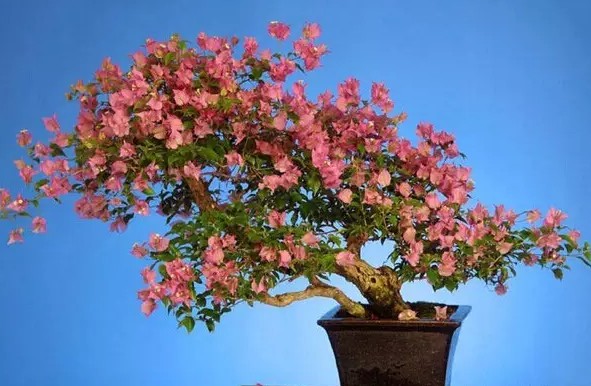
The specific method is to plant several bougainvillea plants together in one pot, with the stems and branches spaced 3 cm apart. After they grow normally, at a suitable height (determined by the desired style), bind them with plastic-covered wire, tying and fastening them tightly. After the growth has set into shape, loosen the binding, use a knife to shave off the outer bark at the junction of the stems and branches, align the cambium layers, and carry out approach grafting. After the graft union, bind tightly again (protect the wound from rain and watering), and after the growth has firmly formed into one whole, remove the binding wire. The part below the approach graft can be regarded as the root, and can be bent and shaped as needed, or matched with stone to form a root-clasping-stone. Strengthen management; the part above the approach graft will grow many branches, which should be pruned according to the intended design, removing surplus branches.
It should be noted that when pruning, you must proceed according to the overall image you have conceived, and be sure to have a clear plan before cutting, never proceeding blindly. The remaining branches after pruning should be further wired and shaped. As time goes on, the part below the approach graft will form a new trunk, but its surface will be rough and uneven, making it appear even more vigorous and antique.
Through continuous pruning and shaping, the goal is to achieve roots and trunk that are elegant, refined and unusual, and a crown that is lush and richly layered. In this way, a pot of bougainvillea bonsai with exposed roots and claws and a profusion of blossoms can be created.
Making bougainvillea bonsai is relatively easy. Depending on the condition of the potted plant, it can be trained into different styles such as single-trunk, double-trunk, slanting-trunk, curved-trunk, lying-trunk, water-and-land, waterside, cascade, pagoda, and flower-basket styles. Below we briefly introduce the method for making bougainvillea bonsai.
Methods for making bougainvillea bonsai:
1. The shaping method is mainly pruning, with tying and binding as a supplement. For young trees, wiring can be done according to the shaping needs, and several bougainvillea plants of different flower colors and varieties can also be planted together for approach grafting as needed.
2. Plant several bougainvillea plants together in one pot, with the stems and branches spaced 3 cm apart. After they grow normally, at a suitable height (determined by the desired style), bind them with plastic-covered wire, tying and fastening them tightly.
3. After the growth has set into shape, loosen the binding, use a knife to shave off the outer bark at the junction of the stems and branches, align the cambium layers, and carry out approach grafting. After the graft union, bind tightly again (protect the wound from rain and watering), and after the growth has firmly formed into one whole, remove the binding wire.
4. The part below the approach graft can be regarded as the root, and can be bent and shaped as needed, or matched with stone to form a root-clasping-stone.
5. Strengthen management; the part above the approach graft will grow many branches, which should be pruned according to the intended design, removing surplus branches.
Warm tips:
When pruning, you must proceed according to the overall image you have conceived, and be sure to have a clear plan before cutting, never proceeding blindly. The remaining branches after pruning should be further wired and shaped. As time goes on, the part below the approach graft will form a new trunk, but its surface will be rough and uneven, making it appear even more vigorous and antique.
Summary:
Through continuous pruning and shaping, the goal is to achieve roots and trunk that are elegant, refined and unusual, and a crown that is lush and richly layered. In this way, a pot of bougainvillea bonsai with exposed roots and claws and a profusion of blossoms can be created.