Detailed Explanation of the Methods and Steps for Making Juniper Bonsai
Juniper, also known by people as Chinese juniper, is an evergreen tree of the Cupressaceae family. Because it can be enjoyed in all four seasons, it has relatively high ornamental value and is also widely used in landscape design, making it a tree species deeply loved by people. Although its landscape application is the most common way it is used, because its tree form is naturally elegant, there is no reason it cannot also be used to make bonsai.
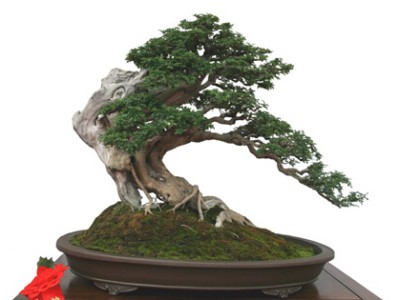
Compared with its landscape use, the bonsai use of juniper is somewhat less common, but it is by no means absent, and it is also very beautiful. It can effectively improve the quality and feng shui of a room, making it very suitable for indoor placement.
I. Material Collection
Dig up old juniper stumps from the mountains and wild, preferably in early spring when the ground has thawed but the trees have not yet begun to sprout. After collection, they must go through a certain period of "blank cultivation" until the root system develops and the old trunk produces new juniper needles, after which they can be potted and processed. When the main trunk of seeded seedlings grows to a certain thickness, they can also be made into bonsai through pruning, and their branches and trunks are highly malleable and can be processed into various forms.
II. Potting
Pot selection: Juniper bonsai should preferably use purple clay pots or glazed ceramic pots to set off their emerald green branches and leaves. Generally, curved-trunk styles mostly use rectangular pots, while straight-trunk styles use medium-deep round pots or oval pots; cascade styles should use tall, deep cylindrical pots.
Soil: Fertile, loose, and well-drained sandy loam is best. For home potting, mature garden soil or leaf mold mixed with an appropriate amount of sand and chaff ash can be used as the growing medium. For old-stump bonsai, mountain soil is best.
Planting: Potting is best carried out from March to April. Both seedlings and old stumps must retain some original soil or a complete root ball. The drainage hole at the bottom of the pot should be covered with a piece of tile, then a layer of coarse sand should be added to facilitate drainage.
III. Shaping
Juniper branches and leaves grow densely and remain emerald green all year round. Digging up old juniper stumps from the mountains and wild to cultivate bonsai, and through processing and shaping, makes the trunk twisted, the branches and leaves clustered, with a momentum like a roaming dragon and foliage like an emerald canopy, so that it has the characteristics of an ancient juniper bonsai. After being carved, the juniper trunk is twisted and bent without showing traces of axe or knife; the branches are tied and bent in gnarled curves without appearing artificial. The juniper tree is inherently firm by nature, yet its crafted posture is supple, combining hardness and softness, ingeniously varied, antique and majestic, so that it can captivate people.
Juniper bonsai shaping can be achieved through tying and pruning to create straight-trunk, slanted-trunk, curved-trunk, or cascade styles. The branches and leaves are pruned into semicircular or layered forms. Shaping should preferably be done after autumn. Usually, the top shoot is cut off first to encourage side branches, removing the strong and keeping the weak, removing the tall and keeping the short, controlling growth so that the branches and leaves become full and the posture antique.