Detailed explanation of pomegranate bonsai making techniques, step by step teaching you how to do it
The pomegranate is a deciduous tree or shrub of the genus Punica in the family Lythraceae. It blooms in summer, with large and brightly colored flowers and a long flowering period, making it a relatively good tree species for viewing flowers, fruits, leaves, and form. There are many pomegranate varieties, mainly divided into fruit pomegranates grown mainly for fruit and flowering pomegranates grown mainly for flowers. Pomegranates like warmth and sunlight, are cold-resistant and drought-resistant, and are not tolerant of waterlogging, and they are not demanding about soil.
For making bonsai, you can choose dwarf varieties with a short plant form, small leaves, and small flowers and fruits, such as the fire pomegranate, four-season pomegranate, and agate pomegranate; or choose large-flowered, brightly colored, double-petaled flowering varieties, such as the double-flower pomegranate or peony pomegranate; you can also choose red fruit varieties with beautiful fruit shapes, such as Dahongpao and Zhuangyuanhong pomegranate; others such as Sanbai pomegranate and rock sugar frozen pomegranate are also acceptable.
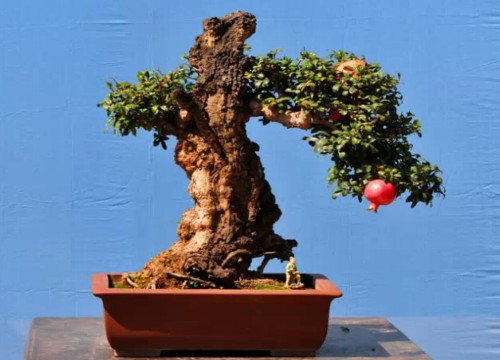
The pomegranate's branches and trunk are ancient and aged-looking, with twisted branches and fine leaves, coiled roots, fine branches and leaves, and large, vivid flowers as red as fire. The fruit shape is peculiar, the color is gorgeous, and it remains on the tree for a long time, with abundant fruit in autumn, as shown in Figure 34. Meaning: “many sons and much blessing.”
1. Source of materials: mainly by cutting propagation, but division and layering propagation can also be used. In winter or spring, cut robust 1- to 3-year-old branches as cuttings for propagation. Softwood cuttings can also be used in summer. Air layering with old branches from large trees can quickly shape the bonsai. To make the seedlings grow quickly, it is best to cultivate the young plants in the ground and strengthen fertilizer and water management.
2. Potting: choose relatively large seedlings cultivated in the open ground for more than 3 years, or choose old pomegranate stumps dug from the wild or bought at a flower and tree market. For making miniature bonsai, smaller seedlings can be chosen. First prepare the growing medium, choose a flowerpot, and pot them when they sprout in spring, slightly exposing the thick roots.
3. Pruning and shaping: tree bonsai are mainly shaped through artistic processing and careful cultivation such as carving, tying and pulling, twisting shoots, pruning, pinching, bud removal, bark peeling, wounding, and bending. The main trunk forms include: straight trunk style, slanting trunk style, curved trunk style, lying trunk style, cascade style, withered trunk style, double trunk style, group planting style, root-over-rock style, etc. For relatively tall pomegranate trees, the method of building up branches and truncating the trunk can be used for shaping.
Pruning is done from after leaf fall in autumn to before sprouting in spring, mainly cutting off water sprouts, strong vigorous branches, overly dense branches, and thin weak branches. The terminal buds and axillary buds of strong branches are flower buds, and terminal flower buds are the most likely to set fruit, so be careful to keep them. Adventitious buds sprouting from the main trunk, main branches, and root crown should be removed in time.
Pomegranates have strong branching ability. When new shoots grow to 10-15 cm, pinch them to help shaping and promote flower bud differentiation. For spring shoots and autumn shoots, methods such as twisting branches, pulling branches, breaking branches, bending branches aside, and bending branches can also be used for shaping. Strong vigorous branches can be pinched multiple times, and overly dense branches and dense needle-like short branches should be cut off. Strong branches sent out in spring are more likely to form flowers, while branches sent out in summer and autumn can be cut off in time, and excess flower buds should also be cut off. To dwarf the tree, during the vigorous growth period of new shoots, spray 2-3 times with a 200-fold dilution of 15% paclobutrazol solution to dwarf the tree.