Detailed Guide to Making Bonsai in Zisha Teapots
Miniature bonsai, as the name suggests, must be small yet not lacking in artistry. At Hongxin Garden in Liming Industrial Zone, the reporter saw that inside small zisha teapots, seedlings of various shapes such as Bolan, red sandalwood, and black pine are uniquely styled with staggered layers, very suitable for placing on desks, bookshelves, balconies, tea rooms, and other places.
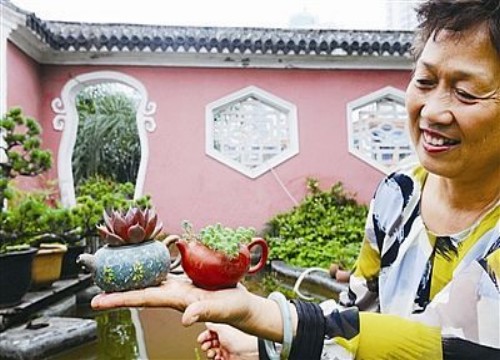
Choosing plants:
Because teapots are small and exquisite and suitable for indoor placement, you should choose shade-tolerant plants suitable for indoor growth, such as Bolan and red sandalwood. In addition, choose robust seedlings with aged trunks and branches at varying heights as material for the teapot bonsai, to facilitate later shaping.
Carry out root combing, branch pruning, and potting of the plant. When combing roots, use finer tools to remove loose soil, cut off rotten and moldy roots, and retain as much of the original soil adhering to the roots as possible. When pruning branches, cut off some crossing branches, inner branches, leggy branches, and other branches to maintain the plant's balanced state. When potting, pay attention to coordinating the plant's orientation with the teapot's inherent tendency; the plant's viewing side should be consistent with the front of the teapot. After the plant is positioned, add soil, and during the process of adding soil, continuously shake the teapot up and down so that the roots come into close contact with the soil, which helps survival.
Bonsai shaping:
Create according to the natural form of the tree stump, guiding it along its tendency. Based on the principles of extending outward on the front side, contracting on the back side, tapering to a pointed top, and arranging branches in an orderly and interwoven manner, carry out ingenious shaping design for the bonsai.
Soaking the pot soil:
After shaping is complete, place the teapot pot in a plastic basin to soak until the water rises to the teapot surface (do not water the pot soil again within the following week), then place the bonsai in a shaded area and spray water on the leaves 2 to 3 times a day (the number of waterings depends on the dryness and humidity of the air). After new buds emerge in about two months, gradually reduce the number of sprays.