A detailed guide to making cliff cypress bonsai, easy enough for beginners to get started
Pine and cypress bonsai, rugged and aged, cold- and heat-tolerant, not choosy about soil, are a “long-lived” tree species and much loved by people. But digging up and transplanting old pine and cypress stumps so they survive is rather difficult, because their sap is in a waxy state and the bark is fragile and easily damaged; once wounded, the resin seals the cut and hardens, sap circulation is blocked, and it is very hard for new buds to sprout, and it may even cause the whole tree to wither and die. Many friends who love pine and cypress bonsai can only sigh over a stump.
1. When collecting wild pine and cypress stumps in mountainous areas, it is very hard to bring along a soil ball, so the collecting season must be chosen with special care. Based on the author's experience, the best season for collecting should be around 20 days before and after “Start of Spring”. At this time the sap of the pine and cypress is about to start moving but has not yet begun to move; digging and sawing off will not cause too much loss of sap, and afterwards, as the temperature gradually rises, the tree quickly recovers and takes hold, making survival easier. If the season is earlier, although the sap is not flowing, the temperature is lower, the recovery time is longer, the recovery of tree vigor is affected, and survival is more difficult.
2. After collecting, when sawing off, keep some branches and leaves according to how many fibrous roots there are: if there are many fibrous roots, keep more; if there are few fibrous roots, keep fewer. How much to keep mainly depends on making sure the water supply and demand between roots and tree body do not fall out of balance, otherwise survival will be affected, because after Start of Spring, as the temperature gradually rises, the sap will begin to flow after planting. If the branches and leaves kept are too short and too few, or none are kept, the sap cannot circulate normally, the waxy resin liquid inside the bark will block the buds, and even if they could sprout they cannot, and the tree suffocates; if too much is kept, the water supply cannot meet demand, which can also lead to death. After sawing, to avoid water loss and reduced immunity, the cuts should be sealed with white latex or plastic film, and the cuts on the roots should also be trimmed smooth with a sharp knife.
3. Collecting, treating the stump and planting should be done promptly; for the initial planting, planting in the ground is best. Use lean old mountain soil that is also well aerated, and do not bury it too deep; it is best to have the root emergence point level with the soil surface, because burying too deep will suffocate it due to poor aeration. Planting should avoid rainy days, and care should be taken to fill the soil firmly around the roots; water the next day, and after watering, shovel some native garden soil to cover the roots, then cut some leafy branches and insert them around the roots to block part of the strong light, so as to protect the base from sunburn, and remove them after autumn. For the planting environment, it is best to choose a place that gets no sun at noon and is well ventilated.
4. After planting, management should keep the soil moist, slightly on the dry side being better. After watering thoroughly to settle the roots, do not water the roots often as long as it is not dry, so as to raise soil temperature and help rooting. When the sunlight is too strong, spray water on the tree body and the soil surface to regulate the temperature difference and help new roots and buds sprout. In hot weather, with the area under the roots moist and cool, ants are likely to cause damage; when watering, you can water once or twice with tea-seed cake water or apply the pesticide Furadan to kill the ants.
5. After survival, take care to prevent rust disease; from late February to late March each year, spray the branches and leaves twice with fungicides such as “Carbendazim” or “Triadimefon”. The interval between applications is 10 days; you can also add a little insecticide such as “Decis” or “Sidedejing” to incidentally kill the small green-shelled snails, so as to prevent the bark of small tender branches from being damaged. Pine and cypress trees have no other major pests or diseases, and after survival they are easy to manage; after the second year, once winter begins, you can do preliminary branch pulling and shaping. Do not rush to peel bark to make shari (deadwood); wait until the branches grow to a certain thickness before pruning and styling.
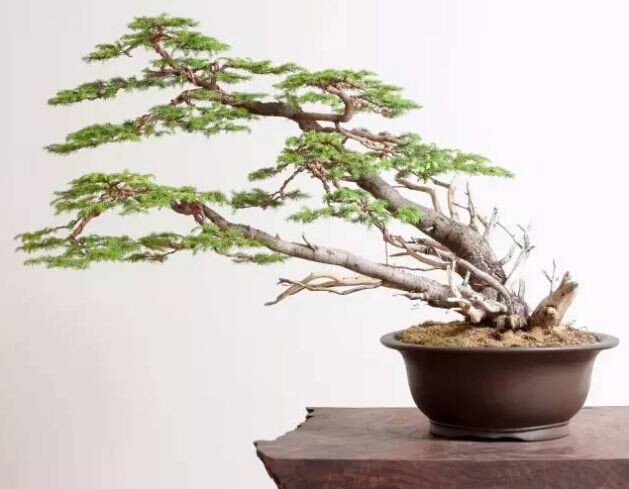
6. After a cliff cypress landscape stump survives, it needs at least one or two years, or even longer, of careful tending: nourish the top branches to be vigorous, the side branches to be strong, the leaves to be plump, and build up branches and roots to make it lush; only then can it be wired and pulled. Cliff cypress can be made into various forms of landscape, but making a landscape requires insight and visual thinking. The Huangling cypress of Shaanxi and the Han cypress of Dai Temple are both regarded as national treasures for their unique character, natural charm and rich historical and cultural connotations; their solid and heroic image is exactly a model and a good teacher for our shaping and landscape making. Image is character, is strength of bone, is charm. In making a cliff cypress landscape, one must respect the tree nature of cliff cypress and respect the image of Chinese arborvitae (Platycladus orientalis). Among Chinese arborvitae bonsai of high level, most have trunks that are twisted and full of strength, ancient and rugged and peculiar; roots emerging in four directions, with a nature for entering the ground; leaf form in clusters; the crown either like cloud clusters congealing rain, or like layered green peaks, mostly triangular and scalene triangular. Cliff cypress styling is extremely suited to a solemn appearance, containing movement within stillness, with a far-reaching artistic conception. Its style should emphasize a scholarly air. Techniques should maximize strengths and avoid weaknesses; absorb both north and south, and be flexible and varied.