How to make a jade leaf bonsai? Detailed production method shared
When the plant propagated by layering has basically taken shape after one year of cultivation, it enters the bonsai-making stage. Bonsai making can be carried out in all four seasons of the year, and based on the thickness of the plant material's stem, its appearance, the unevenness of the branches, and their attachment positions, you can decide whether to make a single-trunk style or a double-plant or multi-plant combined planting style, and then choose a pot suitable for it.
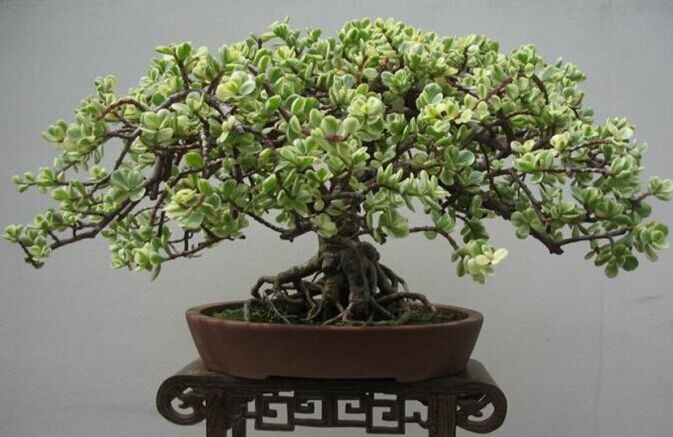
For an ordinary plant with a straight, dignified, and thick trunk, densely arranged internodes, no branches on the middle and lower parts, and more branches on the middle and upper parts that are evenly distributed in all directions, a single plant can be used to make a single-trunk bonsai with an upright, tall trunk.
For the pot, based on the appearance of the plant, choose a round or rectangular blue or green shallow pot; for a plant whose stem bends to one side but whose overall lines are smooth, you can choose a blue or light yellow tall cylindrical pot for planting, making a cliff-style bonsai, but the pot should be lined with more stones and coarse sand to reduce root rot caused by water accumulation in the pot.
For a plant with beauty on one side of its form, you can choose 2~3 plants and successfully achieve the best combination and arrangement, making the main and secondary well-matched, the slant appropriate, and each echoing the other, planted together into a bonsai with the rustic charm of mountains and woods, also possessing elegant quality.
For a combined-planting bonsai, the pot should preferably be a rectangular or oval shallow pot, because it has a larger pot surface space, which can set off the ancient, sturdy tree body and create a unique image, and is also easy to decorate with small stones and accessories.
A newly made jade leaf bonsai may not be very satisfactory, and subsequent pruning is the most important means to achieve its tree-form greening and gradually perfect its composition.
For the parts that need to form crown pads, repeated pruning can be carried out to promote the sprouting of lateral buds on the lower side, producing new branches to form dense crown pads; for overly dense areas, thinning reveals a group tree-form ornamental effect with alternating density; it is worth noting the pruning time, avoid the hottest season and rainy days, and do not water or spray for 1~2 days after pruning, lest its fleshy new wounds become infected with bacteria and mildew, causing the opposite of the desired result.
Because its stem is old and full of wrinkles and nodes, its branches are relatively sparse, and its leaves are rather small, compared with common ficus bonsai, it has more of a simple, straightforward air, and is especially suitable for expressing the spirit and appearance of the evergreen large trees south of the Yangtze River.