Detailed Guide to the Making Methods and Key Points of Smoke Tree Bonsai
Smoke tree (Cotinus coggygria), also known as sumac tree or red leaf. The leaves of the smoke tree are oval-shaped with slender petioles. In early summer it bears small yellow-green flowers in panicle-shaped inflorescences. The stalks of the sterile flowers are pink and feathery, lasting a long time without falling. Viewed at the edge of a dense smoke tree grove, they look like wisps of cooking smoke curling above the forest. In English, the smoke tree is called "smoke tree," which may be how it got its name. The leaves of the smoke tree are emerald green in spring and summer, and all turn red in late autumn, gorgeously lovely. Traveling to the mountains and wilds where smoke trees grow densely in late autumn and viewing the mountains covered in red radish is truly refreshing and delightful.
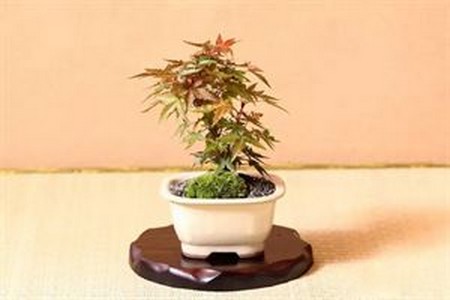
1. Planting and pot selection:
Smoke trees are usually planted before sprouting in spring. If it is a newly dug tree stump, it should be planted in plain sandy soil in a clay pot for "raising the stock"; if repotting, half of the old soil in the pot should be removed and replaced with new soil. Smoke trees are not demanding about soil; a mix based mainly on humus soil with an appropriate amount of sandy soil blended evenly will do. Smoke tree leaves are emerald green in spring and summer and turn red in late autumn, so the color of the pot should be a purple clay pot that harmonizes with red and green. The shape of the pot depends on the tree form: upright trunk styles commonly use round or square pots, while slanting trunk and curved trunk styles are best suited to rectangular or oval pots of medium depth.
2. Tree form creation:
On sunny slopes and semi-shaded slopes in the mountains and wilds of northern China, dense stands of smoke trees often grow. To use them for bonsai, you can go to the mountains and wilds in February to March, before the smoke trees sprout in spring, to dig up old stumps. After years of being cut and gnawed by livestock, smoke tree stumps are short in stature with twisted branches and trunks, showing an aged appearance, and are easy to shape. Therefore, digging up old stumps is a shortcut to making smoke tree bonsai. Smoke tree leaves have relatively long petioles and relatively large blades; after wiring and pruning, they are often made into natural-style bonsai.