Detailed Explanation of the Methods and Steps for Making Literati-Style Bonsai
Literati-style bonsai is more about expressing oneself, while Suren-style is more about one's relationship with the world, placing oneself within the whole world. Therefore, in terms of the styling expression of bonsai, literati-style bonsai wins through various kinds of elegance and refinement, and what it expounds is how the tree form itself stretches out, elegant and refined, forming a posture of a Sumeru immortal; seen from afar, within the entire space, the bonsai is telling its own story.
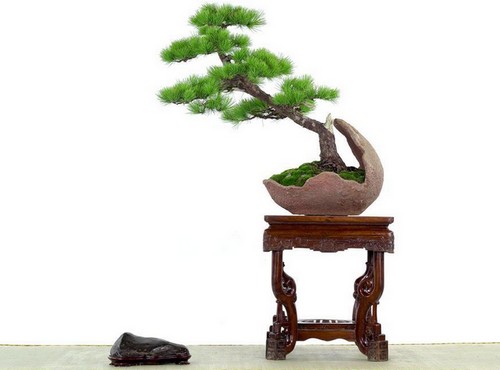
The shaping of literati-style bonsai should begin from a young age, when plasticity is great and subtle bending changes can be made. The shaping is mainly pruning and wiring; pine and cypress species also require appropriate carving. For the selected tree material, after careful observation and consideration and after determining the viewing side, a basic structural pruning can be carried out.
Generally, the branches on the main part of the trunk are cut off first, leaving only the branches on the upper 1/3 of the trunk; sometimes a small number of small branches may also be left on the lower part as embellishment. According to the needs of the styling, the branches on the upper part of the trunk need to be thinned out, and choices must be carefully considered; branches that are not needed should be cut off without mercy.
For the branches that are retained, do not rush to shorten them, so as to leave them for wiring; if the branches are not thick enough, they still need to continue to be cultivated. When pruning pine and cypress species, thick branches can be left at appropriate positions, and after shortening, the bark can be peeled off and processed into jin (dead wood).
After the pruning of the basic structure is completed, wiring and shaping can be carried out. The wiring uses metal wire, and palm fiber can also be used as a supplement to achieve the best effect. In order to protect the bark from damage, it is best to first wrap the main branches and trunk with hemp cloth, and then wrap the metal wire. The order of wiring is trunk first and then branches, large branches first and then small branches, proceeding from bottom to top. For branches that cannot be bent into place in one go, this can be done in several stages.
Pine and cypress species grow slowly, so wiring is the main method and pruning is supplementary. Deciduous broadleaf species have strong sprouting ability, so the method of coarse wiring and fine pruning is mostly adopted, wiring the main branches appropriately and pruning all the small branches.
After the preliminary shaping is completed, they must be cultivated for a period of time before being potted. After potting, appropriate pruning and maintenance management are still required, along with further shaping, so that the styling becomes more perfect.