The Bend-and-Graft Method of Lingnan Penjing: Techniques to Accelerate Earlier Formation
"Trunk chopping and branch training" is the primary artistic technique for creating Lingnan penjing. This method, based mainly on pruning and sawing, produces vigorous, natural, tall and bold large-tree-style penjing. It is the result of long-term shaping by Lingnan penjing artists who draw from nature and learn from nature.
However, this pruning skill of "trunk chopping and branch training" especially requires patience and perseverance, and it also consumes a great deal of time. As the late penjing master Kong Taichu explained in his writings: "Every inch of branch trained takes one to two years. To train a fine penjing with luxuriant branches and vibrant life force requires more than ten or twenty years, or even longer." Truly, as the saying goes, "An inch of branch grows for years on end; only after ten autumns does the fine scenery take shape." How many decades or twenty-year spans does a person have in a lifetime!
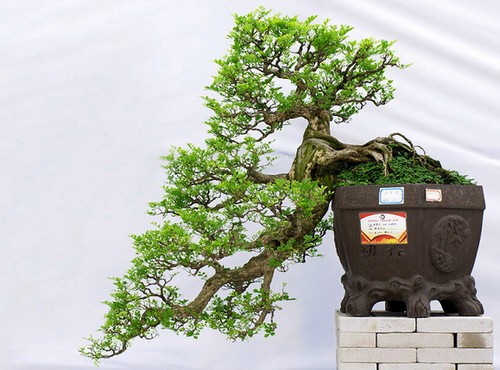
In this era of deepening reform and opening up, people of all walks of life must adapt their lives and work to a "fast pace." "Efficiency is life; time is money." How penjing artists can keep pace with the times, shorten the formation time of Lingnan penjing, and accelerate the results of Lingnan penjing has been one of the main research topics of several Lingnan penjing seminars. Here I briefly analyse the experience of using the "bend-and-graft method" to accelerate the earlier formation of Lingnan penjing, for the reference of fellow practitioners.
1. The "bend-and-graft method": This is the experience and method I have explored over many years in shaping Lingnan penjing branches - namely, skilfully using vigorous long branches that grow on the tree itself which, after matching the proportions of the trunk, are not cut off (not wasted). It is a bending and grafting formation method.
1. Specific operation methods:
(2) Required tools and materials: a sterilised hand saw, a sharp small knife, transparent adhesive tape, small bamboo strips, plastic tubing, aluminium wire, a manual rubber suction bulb, etc.
(3) Determining the bend-and-graft position on the branch: assess the length between nodes of the branch to be bent and grafted, saw a cut with a hand saw to a depth of 1/3 or 1/2 of the branch, then use a sharp small knife to cut the outer side of the saw cut smooth and even. The bending angle is inversely proportional to the slanted cut: the smaller the angle, the larger the slanted cut (be sure to avoid any dead bend).
The direction of the bent and grafted branch, whether upward or downward, left or right, or a floating branch, falling branch, weeping branch, balanced branch, etc., should all be determined at the bend-and-graft point according to the branch shaping design of the tree stump.
(4) Tying and fixing: use a manual rubber suction bulb to blow the wood shavings clean out of the saw cut, then slowly press the branch down to test whether the branch angle is satisfactory and whether the saw cut fits together; if not, adjustments must be made. Then, use aluminium wire to drive a small steel nail into the trunk at an appropriate place at the front end of the bent branch, and add a small bamboo strip at this position to prevent wire bite, and bind it securely. Be sure to make the saw cut fit tightly and accurately.
(5) Pressing the bend-and-graft point tightly, sealing the wound, and eliminating artificial traces: first use transparent adhesive tape to seal the bend-and-graft joint to prevent water seepage and bacterial infection. Then use a short length of longitudinally slit plastic tubing to encircle and tightly press the bend-and-graft joint closed. This can prevent excessive callus growth and raised bark lumps on the tree. Thereby reducing artificial traces and achieving the desired shaping effect.
2. Management of bent and grafted branches: In human society people express love and care toward the disabled and make selfless contributions to support the disabled and help the weak. Perhaps in the plant kingdom there is also such expression, sending nutrients and growth factors to injured and weak branches, so branches that have undergone bend-and-grafting, under conditions free of pests and with normal management, fertilisation, and watering, can all grow vigorously, and the wound heals quickly and well.
(1) Pruning: after a tree stump branch has been bent and grafted, the branch on the side of the wound has its sap and nutrient supply blocked, therefore pruning work should be carried out immediately. Shorten the strong branch of the first section and remove part of the dense foliage. Shorten and weaken the upward-growing lateral branches belonging to the second section after bend-and-grafting. Let the branches that grow downward after bend-and-grafting absorb more sunlight and nutrients, and prompt the bend-and-graft point to heal as early as possible.
(2) Watering and fertilising: after bend-and-grafting, the tree stump should keep the potting soil moist. Water once in the morning and once in the evening; in midsummer, spray water on the branches and leaves. For fertilising, follow the usual fertiliser amount and procedure, and add some additional phosphorus fertiliser to supply the needs of branch growth.
3. Tree stump species suitable for the "bend-and-graft method": Chinese elm (Ulmus parvifolia), Fujian tea (Carmona retusa), small-leaved banyan (Ficus microcarpa), Chinese hackberry (Celtis sinensis), orange jessamine (Murraya paniculata), mountain mandarin (Atalantia buxifolia), azalea (Rhododendron), mountain pine, black pine (Pinus thunbergii), and other species with thick bark, rich sap secretion, and strong wound-healing ability are all suitable for using the bend-and-graft method to promote formation. The best time to carry out the operation is on sunny days after winter dormancy, in spring, summer, or early autumn!
2. The practical value of using the "bend-and-graft method":
Combining the "bend-and-graft method" with the "trunk chopping and branch training method," applied according to the tree, prompts earlier formation in the Lingnan style and can shorten the time by about half.
1. After a newly planted tree stump survives, before pruning at the end of the first year, the growth thickness of the branch supports in all parts is basically balanced. After branch training in the second year, the newly sprouted branches of the first and second lower supports are often slender and weak, with sparse branches and thin leaves, while the remaining branches, especially those around the top, grow vigorously with luxuriant branches and leaves; this is the effect of apical dominance. If the first and second support branches are not cut off and not wasted, and the bend-and-graft method is used to shape the branch form, the main branches of the lower supports can be ensured to continue growing vigorously. The remaining upper branches are shaped using the "trunk chopping and branch training" method. The remaining upper branches are shaped using the "trunk chopping and branch training method." This segmented cultivation can save 2-3 years to achieve the expected effect. If applied to the cultivation procedures for small and medium-sized commercial tree stumps, the efficiency is even better!
2. Example: a orange jessamine (Murraya paniculata) tree stump that has been newly planted and has survived for half a year. The stump head diameter is 8CM, an upright-type trunk. On the right side of the main trunk at 2/3 there is a proportionally matched original stump branch support, and on the left side of the main trunk near the top at a slight bend there is an original stump branch support, moderate in thickness, with pleasing growth, but growing upward at a 45-degree angle. At the lower left there is a claw root connected with the stump head, completed in one continuous flow, with excellent tree spirit. This tree is suitable for making an upright-type large weeping branch. If cultivated according to the conventional branch training method of Lingnan penjing, this large weeping branch on the left might take 5-7 years, and the downward-drooping angle of the first section would be unsatisfactory, appearing rigid. Using the bend-and-graft method to control the floating and weeping angle, choosing the point of this branch support near the main trunk for bend-and-grafting, not only makes it elegant and natural, with dramatic momentum, but also leaves no scar traces. The remaining auxiliary branches and top branches are shaped using the "trunk chopping and branch training" technique, and after 3-4 years the scene can be completed.
We should not rigidly adhere to convention, lazily clinging to traditional things! For traditional artistic techniques, we must both inherit and innovate, and also open up new paths. Let Lingnan penjing artistic creation produce new ideas frequently and stride forward into the new century!