A Detailed Guide to Making Bischofia Tree-Stump Bonsai
Bischofia belongs to the genus Bischofia in the Euphorbiaceae family. Also known as evergreen bishop wood, it is native to China, Japan, Southeast Asia and elsewhere. It is an evergreen tree with a spreading crown and dense branches and leaves; the flowers are unisexual and pale green, blooming from March to April; the berries are spherical and turn dark brown when ripe, fruiting from September to November; it is slightly shade-tolerant, not demanding about soil, can withstand water and moisture, is resistant to pollution and strong winds, and grows quickly, making it an excellent greening tree species for courtyards, streets, factories, schools, gardens and more. It can withstand a minimum of -5°C. The bischofia generally used to make tree-stump bonsai is the multi-trunk bischofia (commonly known as “multi-headed bischofia”), and its stems are naturally aged and rough in appearance and malleable.
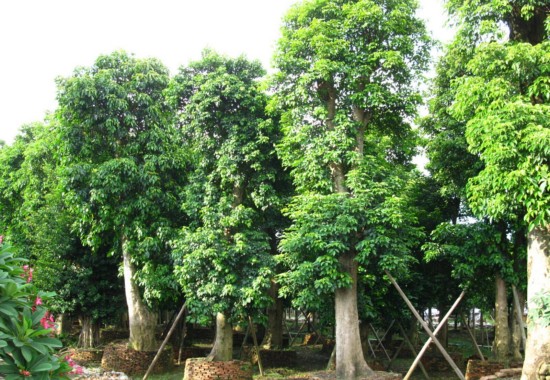
Bischofia is what we usually call the maple tree; it is an evergreen tree species with no obvious dormant period, and even in autumn, when most tree species shed their leaves, it still has very lush branches and leaves, making it highly ornamental. Besides being widely used in landscaping and courtyard planting, bischofia is also often used as raw material for bonsai artistic styling, and bischofia saplings are not expensive, so styling a bischofia bonsai yourself offers relatively good value for money.
Making bonsai from bischofia is nothing new, but finished bischofia bonsai are quite expensive, so learning some bonsai-making methods is very necessary. The method for making bischofia tree-stump bonsai is as follows:
1. Determine the best viewing side of the tree stump, because different viewing sides can produce different styling forms; whichever viewing side is chosen, the principle is to not block or to block as little as possible of the stem, since the main ornamental part of the tree stump is its aged-form stem.
2. Study the overall morphological characteristics of the tree stump, and based on known styling forms and styling experience, predict the finished form. There are two common categories of bischofia styling: forest-style bonsai and branch-pad-style bonsai. The choice between these two categories depends on the stem characteristics of the tree stump. If there are multiple sibling trunks, with stem lengths and thicknesses relatively uniform, stems upright, and no obvious primary and secondary trunks, choose the forest-style bonsai styling method.
3. Setting pads for branch-pad-style bonsai: remove unwanted branches from bottom to top, keeping the original pad positions as much as possible. From bottom to top, each pad is shorter than the one below it; adjacent pads complement each other in direction, alternate pads can echo one another, and the bottom pad and top pad work together.
4. Creating pads for branch-pad-style bonsai: with the help of rubber strips, long bamboo slats and iron nails, set the direction of the pad positions; regardless of direction, every pad must grow horizontally into a spherical shape.
5. Forest-style bonsai styling is relatively simple: remove branches and trunks from bottom to top, keeping only the top branches to create pads. The pad positions of the top branches also need to work with one another, so that pads extend evenly to the front, back, left and right.
6. Finally, make a clear estimate of the work's finishing time, and purposefully cultivate the branch pads. After the tree stump's pads are set and created, the final length of the pad-position branches and the overall pad character must be determined according to the tree stump's growth, so as to achieve even growth across the whole stump and finish within the planned time.
It seems that making a pot of bischofia bonsai is no easy task after all; there are quite a lot of details to pay attention to, no wonder bischofia bonsai on the market are relatively expensive. Speaking of which, learning to make bischofia bonsai is also equivalent to learning a craft.