How to create azalea bonsai to enhance its overall ornamental value
When azaleas are in full bloom, they cluster together like brocade, brilliant and colorful. Spring azaleas, summer azaleas and Western azaleas have different flowering periods by variety, usually blooming successively from April to July, and are widely recognized as the best ornamental flowering trees and shrubs. If measures are taken to control suitable temperature, humidity and light, and ensure fertilizer supply, azaleas can be brought into bloom early for the Spring Festival. The poet Bai Xiangshan praised them in the poem "Mountain Pomegranate Flower": “Glorious and radiant, unmatched among flowers. Their enchantingly beautiful blooms suit a small courtyard, their short branches fit a low corridor. Once a thing of the mountain heights, now fragrant beneath the steps. A thousand clusters face and back one another, ten thousand blossoms rise and fall in turn. They glow against the red railing, their delicate beauty reflected on the whitewashed wall.” This depicts the ornamental value of arranging azaleas in a courtyard garden.
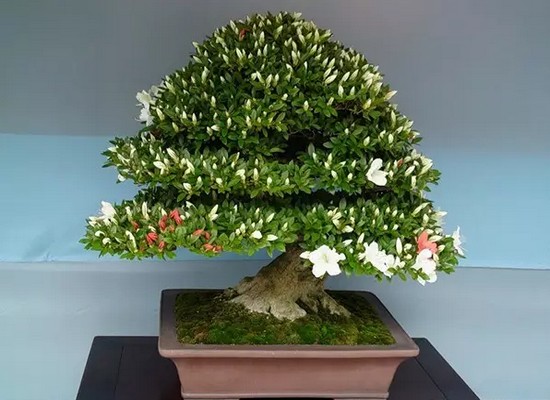
Azaleas have a long history of being cultivated as bonsai in our country. Especially in recent years, with economic development and technological progress, azalea bonsai cultivation techniques have become quite mature, and high-quality academic articles appear in newspapers and periodicals from time to time. I have been engaged in azalea cultivation and bonsai making for more than 10 years, and have collected more than 200 pots of azaleas with different flower colors and different petal forms. On the basis of research by predecessors and contemporary experts, I also have some modest experience in collecting azalea stumps in the wild, acclimatizing and planting them, grafting, potting, styling and management. Although it is superficial, I am willing to offer it to everyone as a stone from another mountain.
In creating azalea bonsai, two misunderstandings easily arise: first, that a flower-viewing bonsai is a flowering plant, so as long as the root crown is large, the external shape roughly meets the general requirements of bonsai, the flower color remains bright, and growth is vigorous, it can enter the “hall of elegance”; second, that because azaleas grow relatively slowly and their branches are difficult to thicken, one cannot draw on the technique of “storing branches and truncating the trunk” used for deciduous broadleaf bonsai, so when viewed, they often appear “dazzling” at full bloom, but after pruning and “stripping off their clothes,” a serious imbalance in the proportion of trunk to branches is revealed. I believe some exploration and experimentation should be done in this regard. Since azalea is both a bonsai and something whose flowers are to be appreciated, one must follow the basic rules and inherent requirements of bonsai creation to enhance its overall ornamental value.
First, select good raw stock. Whether azaleas are purchased from the market or collected in the wild, there is no lack of raw stock with thick trunks, unusual trunk forms and a stable root base. After obtaining these relatively good azalea resources, one should, as with making other tree-stump bonsai, repeatedly consider, conceive the composition, and truncate the stock to establish the design. While excavating the brightest “highlight” of the raw stock, one should retain as many original transitional branches as possible. Doing this preliminary foundational work well prepares the way for determining the later positioning of stored branches. For the relatively thick transitional branches that are retained, even if their branch direction is not ideal, they can be handled through “surgery.”
Second, overcome the mentality of rushing for success. A beautiful azalea bonsai work cannot be completed in one year or even 3 to 5 years; it requires a long period of time and hard sweat. This is the meaning of the saying, “The scene is completed in a day, but the work lies in ten years.” According to my practice, for newly sprouted shoots cultivated as first-level transitional branches to reach a relatively ideal thickness, it takes at least 6 to 7 years, and at most 8 to 9 years. This requires us to endure loneliness, hold fast to time, and overcome impatience and the mentality of rushing for success.
Third, pay attention to management and accelerate branch growth. As the saying goes, “If you want the horse to grow well, the horse must eat its fill.” Plant growth cannot be separated from basic survival conditions or from sufficient “nutrition,” and the management of soil, fertilizer and water is an important factor in providing basic conditions for azalea growth. Colleagues have already discussed these aspects, and their experience has greatly inspired me. In order to speed up the rate of branch storage and unrestricted growth, besides following the laws of soil, fertilizer and water required for azalea growth, I also pay attention to doing three things:
First, apply thin fertilizer frequently. Applying thin fertilizer frequently does not mean fertilizing at fixed intervals, but rather using diluted fertilizer water as a routine watering operation. Around the area where I place the bonsai, I set up several water vats. In the vats, fermented rapeseed cake and bone materials are kept year-round and diluted with water. During the azalea growing period, this is applied by manual watering, after which clear water is used together to apply leaf-surface water.
Second, let the cultivated branches bloom as little as possible. Around late September to early October each year, azalea flower buds have already taken shape, and all flower buds should be removed. This can reduce the azalea's internal consumption, and after the following Start of Spring it directly enters the growth period (some also cut off the branch tips, so that after new shoots sprout they enter the growth period the following year).
Third, wipe off excess tender shoots. Azaleas have strong sprouting ability. After pruning, many new shoots often sprout quickly. According to the needs of the styling, excess new shoots should be wiped off to concentrate nutrients and ensure the growth of the branches that should be retained.