How to make a Chinese juniper bonsai? Detailed explanation of the techniques and methods
Chinese juniper, also known as juniper, Taiwan juniper, and needle pine, is an evergreen tree of the genus Juniperus in the Cupressaceae family. Its bark is brown, with longitudinal grooves, and peels off in strips. The branches are sparse and grow upward, while the branchlets droop, are triangular in cross-section, initially green, and later turn reddish brown. The leaves are borne in whorls of three, needle-shaped, with sharp tips, a slightly concave surface, and a slightly raised midrib. The leaves are green, each with a white stomatal band on both sides, which merge into one at the leaf tip.
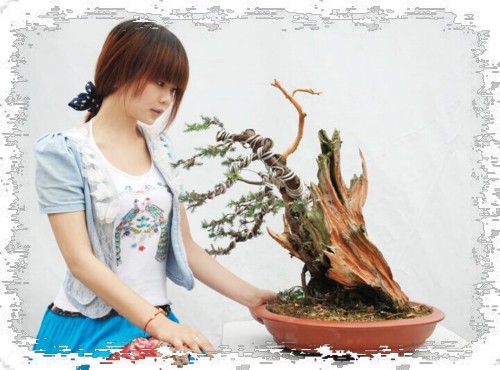
The trunk of Chinese juniper is vigorous and ancient-looking, the foliage is emerald green, it stays evergreen through all four seasons, and the branches are supple and easy to shape, making it a good tree species for making bonsai. However, Chinese juniper prefers a warm, humid environment with plenty of sunlight, is slightly shade-tolerant, and tolerates cold and drought. A well-made bonsai can be placed outdoors in a sunny, well-ventilated spot for care. Do not use too much fertilizer or water, so as to avoid excessive vegetative growth that affects the beauty of the tree shape. Small bonsai should be repotted every 2 years, and large bonsai every 4 to 5 years, generally before budbreak in spring. When repotting, cut off diseased roots, rotten roots, and some old roots, thin out dense roots, remove 1/2 to 1/3 of the old soil, and replace it with fresh fertile potting soil before replanting.
Chinese juniper used for making bonsai can be propagated by sowing, cuttings, layering, and other methods. You can also choose old tree stumps that have grown for many years, are short in stature, and have an aged, gnarled form to make bonsai. Digging and transplanting are mostly carried out in winter or before budbreak in early spring. Before transplanting, first thin out the branches according to the shape of the stump, cutting off all unnecessary branches. When digging, cut off the main root and keep more lateral roots, fine roots, and fibrous roots. It is best to transplant with a soil ball; for bare-root plants, do a good job of keeping the roots moist and fresh. First plant them in plain sandy soil to grow the stock. When there are many, they can be planted in the ground; when there are few, or for those living in apartment buildings, they can also be grown in pots to build up the stock.
After planting, firm the soil, water thoroughly, spray with water once, and then cover the plant with transparent plastic film to keep it warm and humid. In spring, as the temperature rises, the stump will gradually sprout. When the temperature inside the plastic film is too high or the humidity is too low, open a corner of the plastic film to ventilate and cool it down, and replenish water in time, but the soil must not become waterlogged, so as to avoid root rot. After the plant grows steadily, gradually remove the plastic film. For surviving stumps, let them grow freely in the first year, and do not shape them either. Wait until the spring of the second year, then move them into loose, breathable, well-drained sandy soil and carry out shaping.
For young Chinese juniper trees propagated by sowing, cuttings, or layering, wire can be used for bending and shaping. When wiring, make as much use as possible of the tree trunk's original form, and train them into different styles of bonsai, such as single-trunk style, slanting-trunk style, curved-trunk style, waterside style, cascade style, and root-over-rock style. For old stumps that have grown for many years, the shaping should vary according to the tree. Refer to the forms of cypresses in nature and ancient cypresses in paintings, and use the method of coarse wiring and fine pruning to express the cypress's posture of being both aged and ancient-looking and full of vitality.
When wiring Chinese juniper, wire is often used to wrap, twist, and bend at the same time, which some people call the "tendon-twisting and bone-turning method." When wiring the main branches, press downward along the direction in which the wire is twisted to prevent the base from splitting open. When the wire begins to cut into the branch, it should be removed in time. If the shape does not meet the requirements, it can be rewired to avoid causing scars. For old Chinese juniper stumps, if needed, part of the bark can also be peeled off along the bark fibers and coated with lime sulfur mixture to create "shari" or "jin," making them look aged and rugged. When peeling the bark, follow the twisting water line of the stump to achieve the artistic effect of "coming from nature, yet higher than nature."
During the growing season, keep the bonsai soil moist, and water according to the principle of "do not water until dry, and water thoroughly when you do," and do not give "half watering." When the air is dry, spray water on the leaves to increase air humidity and keep the leaf color fresh, but pay attention to drainage during consecutive rainy days. Apply a thin, fully decomposed liquid fertilizer once each at the end of April and in early September. In winter, place it in a cold room or bury the whole pot outdoors in a wind-sheltered, sunny spot to overwinter, and do not water too much. Pruning and shaping of Chinese juniper bonsai are best done in winter. Cut off excess branches, branches with poor angles, and other branches that affect the tree shape. For overly long branches, pinch them back during the growing season to promote new buds and make the branches and leaves dense.