Detailed Guide to Making Ginkgo Fruit-Bearing Bonsai
The ginkgo tree, also known as the white fruit tree, was called the duck-foot tree or the grandparent-grandchild tree in ancient times. It is one of the most precious tree species in the world and the only species of ancient ginkgo plants still surviving on Earth, which is why botanists regard it as a "living fossil" of the plant kingdom, and together with the cedar, the Norfolk Island pine, and the golden larch, it is known as one of the world's four great garden trees. Chinese horticulturists also often mention ginkgo alongside peony and orchid, hailing them as the "three treasures of the garden," and revere the ginkgo as the national tree.
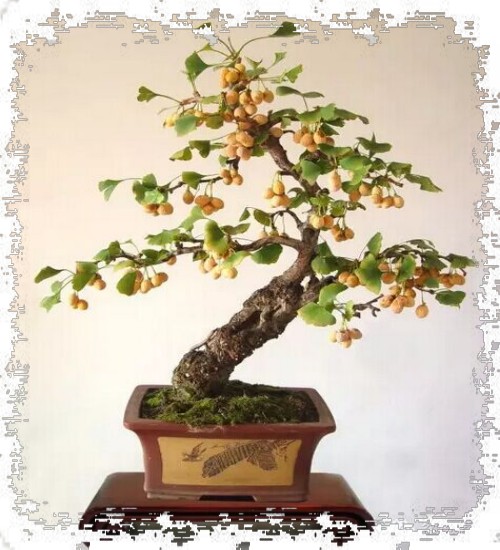
Ginkgo fruit-bearing bonsai can be divided into: A Single Branch Standing Out (single branch), Wings in Flight (two branches), and Three Legs of a Tripod (three branches).
Materials:
Bonsai soil: Use fertile fine soil and organic fertilizer (such as rapeseed cake or animal manure), mixed with 0.5% high-quality N, P, K compound fertilizer, and compost until thoroughly decomposed.
Production:
Leave 4 to 5 small holes in the lower part of the middle container for aeration and drainage. The ginkgo bonsai rootstock can be grown either from seeds or from 1- to 3-year-old seedlings. Pinch the growing tips of the ginkgo seedlings and cultivate them respectively into: single-branch, 2-branch, and 3-branch rootstocks, to correspondingly produce "A Single Branch Standing Out," "Wings in Flight," and "Three Legs of a Tripod." Place the middle containers that have been sown or planted with seedlings on flat ground in a 0.5 m × 0.4 m layout, and cover the surrounding area with fine soil to retain water and nutrients.
Planting of seedlings is done in October. Sowing is done in spring. Grafting is done in autumn, when the temperature is 12-16°C (mid to late March).
Grafting:
Collect 1- to 3-year-old flower-bud branches from the middle part of a fruit-bearing mother tree, and graft using the cut grafting or cleft grafting method: the "A Single Branch Standing Out" scion can use 3-4 flower buds, preferably with a terminal bud; the "Wings in Flight" and "Three Legs of a Tripod" scions each take 2-3 flower buds per branch.
Grafting at this time allows the graft union both to heal and not to sprout, and it will bloom when the weather warms the following spring. After the female flowers mature, hand pollination is carried out. Forty-five days after pollination, the ovules are visibly enlarged and the seeds enter their period of rapid growth; keep 2-3 seeds per branch, strengthen water and fertilizer management, and seeds will grow from the flower buds while new branches also emerge.
In June, the middle container can be removed and the plant transplanted into pots for the flower market, which is bound to yield considerable economic benefits.