Detailed Explanation of the Production Method and Steps for a Michelia Bonsai
Michelia, also known as Pidai Xiang and Shanzhenzi, is an evergreen shrub or small tree of the genus Michelia in the family Magnoliaceae. Together with ginkgo, it belongs to the Mesozoic tree species that survived after the Quaternary glaciation, and is commonly known as a "living fossil." Although no true wild place of origin has yet been discovered, it is widely distributed in broad-leaved or coniferous open forests of the eastern Yunnan and central Yunnan plateaus, and even along roadsides and streams.
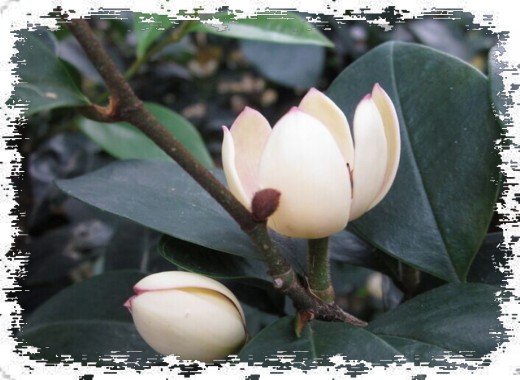
Michelia is 3 to 4.5 chi tall, much branched, and the branches are hairless. The leaves are simple and alternate, leathery, oblong-elliptic or obovate-lanceolate, with entire margins; the petiole is about 2 cm long, both surfaces are hairless and glossy, and the netted veins are clearly visible. Buds are present in the leaf axils, covered with reddish-brown hairs; the flower buds are enclosed by large bracts, and the bracts are densely covered with brown silky hairs, slightly opening. The flowering period is 2 to 3 months, and it is extremely fragrant. The aromatic oil content is about 0.4 percent, making it an important fragrance for the food and cosmetics industries.
Because of cutting by woodcutters, gnawing and trampling by livestock, and in addition the barrenness of its habitat and the fragrance inherent in the bark of Yunnan Michelia itself, it greatly attracts ants to nibble on it. Therefore, it is very easy to find stumps that are short and sturdy with dense branches, highly varied, covered with scars, rugged as bare bones, ancient and crooked, and with gnarled, intertwined roots. Thus, Yunnan Michelia has very high ornamental value.
Michelia has relatively strong adaptability and still grows well at a temperature of 5 degrees Celsius. Therefore, it can only be collected after entering winter, and collection before the leaves shade over in February and March gives an even higher survival rate. Before collecting, first select a stump that is short and sturdy, has a trunk with relatively good variation, natural transitions, well-proportioned branching, and relatively good prospects for development.
Then hold the trunk with your hand and shake it forcefully. If the stump shakes relatively easily, then that stump is very likely to have unbalanced roots or few fibrous roots, with only one or two main roots; this stump should be abandoned, as it is relatively difficult to keep alive. If the stump appears steady when shaken, and the pull felt around the stump during slight movement is clearly perceptible, this type of stump generally has well-developed fibrous roots and is easy to dig up and maintain.
Of course, the above method has its limitations. As far as possible, widen the digging area, use force carefully, disturb the fibrous roots as little as possible, and the main roots may be cut off. Wrap the entire stump all over with a large plastic bag, spray a little water inside the bag or put in some moisture-retaining moss to reduce the consumption of nutrients and water. For broken roots, split roots, and overly long thick roots, cut them short and smooth; cut away the excess useless branches and leaves, then place the entire stump all over into a 0.5 percent potassium permanganate solution to disinfect for ten minutes, and apply 500 ppm indolebutyric acid to the roots. For planting, it is best to choose a clay pot or wooden box; the potting soil is 5 parts river sand and 5 parts leaf mold mixed evenly, and the stump is placed in the clay pot.
When potting, it is best to use a bamboo stick so that the soil and fibrous roots combine organically. Water thoroughly, cover the entire stump with a plastic bag, tie the opening of the plastic bag tightly at the base of the stump, leave the entire clay pot and soil surface exposed outside, leave one or two small holes in the plastic bag for ventilation, and place it in a ventilated, shaded place. Treated in this way, it not only ensures the corresponding humidity and temperature for the stump, but also satisfies the conditions for the fibrous roots to exchange air. Potassium permanganate has an inhibitory effect on anaerobic bacteria and also prevents the growth of mold in a high-humidity environment, reducing the possibility of the stump rotting.
Yunnan Michelia is most afraid of waterlogging, and it is best to keep the potting soil slightly dry; this is the key to survival. From May to June, when new leaves have sprouted to 10 cm, gradually burn holes in the plastic bag with a cigarette butt so that the stump gradually adapts to the outside climate, and only then can the plastic bag be completely removed.