Detailed Explanation of the Production Methods and Techniques for Chinese Holly (Ilex crenata 'Convexa') Bonsai
Chinese Holly (Ilex crenata 'Convexa') gets its name because the raised surface of its leaves resembles a turtle shell. It is an evergreen small shrub of the genus Ilex in the family Aquifoliaceae. The old trunk is grayish-white or grayish-brown, and the leaves are elliptical, alternate, and entire. New leaves are tender green, while old leaves are dark green, relatively thick, leathery, and glossy. Its branches and trunk are vigorous and ancient-looking, and its leaves are dense and deep green, making it very suitable for making bonsai.
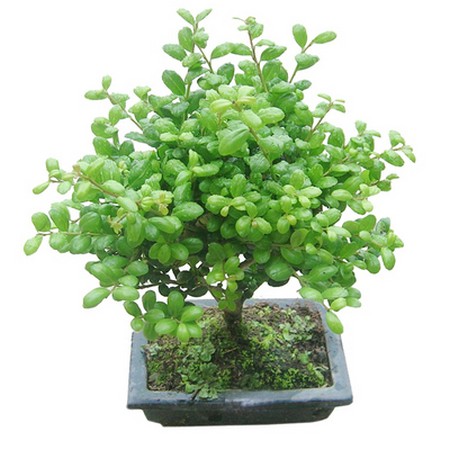
The old trunk is grayish-white or grayish-brown, and the leaves are elliptical, alternate, and entire. New leaves are tender green, while old leaves are dark green; relatively thick, leathery, and glossy. Its branches and trunk are vigorous and ancient-looking, and its leaves are dense and deep green, with good ornamental value. In landscaping, it is often planted in masses as ground cover trees, and is also commonly used for colored blocks and colored strips as foundational planting. It can also be planted in flower beds, tree beds, and at intersections of garden paths, all with excellent ornamental effects. The ground cover has a fine texture, and after pruning, the outline is distinct and the shape is maintained for a long time. Because of its extremely strong growth ability and tolerance to pruning, it is often used as ground cover and hedges. It can also be used as a potted plant. Landscape uses include bonsai and courtyard ornamental planting.
Chinese Holly bonsai can be processed and made into various forms according to different tree stumps, such as single-trunk style, double-trunk style, slanting-trunk style, curved-trunk style, dead-wood style, waterside style, and cascade style, among other variously shaped bonsai. The crown mostly adopts a vigorous large-tree shape or a neat round disc shape. It is also possible to plant several 2-year-old young trees together to make a forest-style bonsai. When planting, pay attention to the staggered heights of the trees and the variations in front, back, left, and right, so as to achieve both clear primary and secondary relationships and harmonious unity. The shaping method for Chinese Holly bonsai should combine wiring and pruning. First use metal wire to bend out the basic form, then carefully prune to bring it into shape.
Chinese Holly used for making bonsai is usually propagated by cuttings, generally carried out during the growing season from May to July. For the cuttings, healthy and full branches from the previous year or the current year can be selected, with the lower leaves removed. After insertion, place them in a location with bright light but no direct sunlight for care, keep the soil and air moist, and roots can form in about 50 days.
You can also choose old branches with beautiful posture and propagate them during the growing season by air layering. After they take root, cut them off and plant them in a pot, and they become a beautiful bonsai. Large and medium-sized bonsai can also be made from old stumps that have grown for many years. Their transplanting is mostly carried out before sprouting in spring. Before planting, first prune and shape the tree stump, cutting off unnecessary branches and overly long roots. After planting, water thoroughly once, then keep the soil moist and frequently spray water on the branches and trunk to increase air humidity, which is beneficial for the plant's survival.