Detailed guide to making strawberry bonsai, easy to learn at a glance
Yesterday morning, Xu Peiying, a member of the Haifeng Farm Professional Cooperative, showed the strawberry bonsai they grow. The cooperative used seedling greenhouses to grow more than 3,000 pots of strawberry bonsai. At present, the strawberries in the bonsai have begun to bloom and bear fruit, and the whole greenhouse gives off a faint sweet fragrance. According to the introduction, one pot of strawberry bonsai can bear 2 jin of strawberries. Sold as a bonsai, it can fetch about 80 yuan.
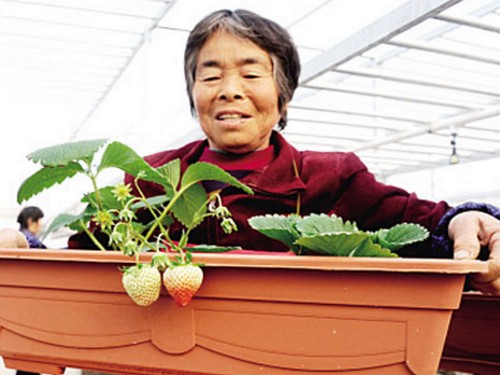
Strawberries are not only delicious, but also a potted plant that combines foliage, flowers and fruit in one, with relatively high ornamental value.
1. Advantages of pot cultivation: Strawberry fruit has a fresh, fragrant and refreshing taste, bright red color, and an elegant and beautiful shape. After potting, the plant is petite and the fruit-bearing ornamental period is long. White flowers, green leaves and red fruit set each other off. When placed in a room (a clay pot can be covered with a white plastic pot for a better look), its ornamental effect is just like that of flowers, and it can also be eaten, achieving two things at once.
2. Variety selection: Strawberry belongs to the Rosaceae family as a perennial evergreen herbaceous plant. There are many varieties suitable for pot cultivation. It is advisable to choose varieties with shallow dormancy, good fruit shape and rich aroma. For example, Das Select, Toyonoka, Shizuka, Taida No. 1 and others are more suitable.
3. Pot soil preparation: Select high-quality vegetable garden soil, leaf mold and organic fertilizer, and mix them in a ratio of 3?1?1 for later use. When mixing, do not use soil that has previously grown strawberries, to prevent the occurrence of continuous cropping diseases.
4. Temporary planting: In mid-to-late August, select robust seedlings and plant them temporarily in small flower pots. Strawberry seedlings are required to have three leaves and one heart, and a well-developed root system. With a thickness of 1 to 2 mm, the planting depth should be shallow enough not to expose the roots and deep enough not to bury the heart. After planting, place them in a dark place to recover for about 5 days.
After the seedlings recover, keep the pot soil alternately dry and wet in the sunlight, but it must not be too dry, so as not to affect growth. During the temporary planting period, control nitrogen fertilizer and increase phosphorus and potassium fertilizer to cultivate strong seedlings. The fertilization concentration is generally 0.2%, once every half month.
5. Final planting: In early October, plant them in flower pots with a diameter of about 20 cm. First place a tile at the bottom, put the prepared soil into the pot, and press it slightly firm, with the height being half the height of the flower pot.
Then take 3 to 4 strawberry seedlings and plant them with the arched back facing outward, because the direction in which strawberries bloom and bear fruit is consistent with the direction of the arched back, so this can make the flowers and fruit exposed outside the flower pot, with the fruit coloring evenly and neatly, looking beautiful. After final planting, water thoroughly once to help the seedlings recover.
6. Management after final planting: Water plays an important role in the growth of strawberries. After final planting, be sure to keep the pot soil moist and not dry, and water frequently in small amounts so that the plants grow robustly. After the seedlings recover, water with dilute soybean cake water about once every half month until flower buds appear. When watering, slowly pour from below the leaves to keep the leaf surface clean and beautiful.
7. Management during the flowering and fruiting period: Spray gibberellin once in late October to promote flower bud differentiation. After flower buds appear, thin flowers and fruit in time. Remove small, rotten, diseased and deformed flowers and fruit, as well as side buds extending from the leaf axils, and remove old leaves and diseased leaves to increase ventilation and light transmission.
8. Management after fruiting: After fruiting ends, no longer remove side buds. Keep 3 to 5 side buds to form runners, and grow them indoors as hanging ornaments.