Detailed Explanation of the Methods and Techniques for Making a Goji Berry Bonsai
Spring, a season when all things revive, is when people want to grow a few pots of flowers, both to beautify the home and to cultivate their character. Bonsai is the cream of the crop among them, but the price is naturally not cheap. Have you ever thought of making a bonsai yourself? Goji berry is a specialty of Ningxia, and in ancient times it was even one of the Eighteen Scholars of bonsai. The goji berry stump bonsai has an elegant posture, with drooping branches and purple flowers, and in autumn red berries cover the branches, giving an excellent ornamental effect. Today we will share with you how to make a goji berry bonsai.
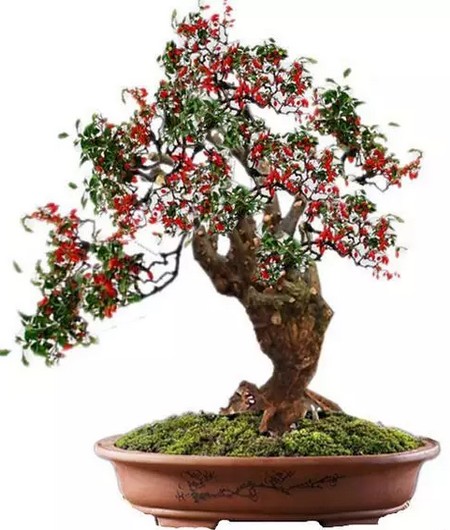
For goji berry bonsai we generally use old tree stumps. Old tree stumps can be made into many forms of bonsai. However, their branches are relatively long, and short branches rarely bear fruit, so apart from the weeping-branch style bonsai, other forms of bonsai find it difficult to present a scene of abundant fruit on the ideal branch pads.
The goji berry has two growth periods and two dormancy periods in a year. The dormancy periods are the severe cold of winter and the hot dog days of summer. The winter dormancy period is longer, about four months, while the dormancy period in the dog days is shorter, one month. Thus the growth periods are divided into the first-half-year growth period and the second-half-year growth period. The first-half-year growth period is mainly vegetative growth, only growing branches and leaves without flowering or fruiting; the second-half-year growth period is mainly reproductive growth, flowering and fruiting while growing branches and leaves.
According to this characteristic, during its first-half-year growth you can give it plenty of water and fertilizer to let it grow more branches and leaves, without pruning, so that it stores more nutrients; during the short dormancy period in the dog days, prune and shape it; during the second-half-year growth period, use techniques such as pinching off the tips, pinching the branches, and needling to make it branch more, age the branches early, and bloom more. In this way you can enjoy a goji berry bonsai with dripping red berries.
1. Processing: The main branches and trunk of the goji berry can be appropriately bent and pruned. Large branches are best bent and pruned in winter; small branches can be bent in summer and autumn. New branches can be bent at any time with suitable metal wire such as iron, lead or copper. Goji berry wood is relatively brittle, so when working, pay attention to using gentle force and do not be too rough.
2. Tree shape: For making an old-stump goji berry bonsai, it is generally best to create a curved-trunk style or a cascade style, while small branches are best trained to droop. A raised-root design can be made into a bridge style. There are also other styles such as the figurative style, raised-root style, multi-trunk style and eccentric style, but the big-head-small-tail and straight forms are the most uninteresting. In short, shape according to the tree, apply skills according to the material, and work at it repeatedly without rushing.
In winter the goji berry bonsai should overwinter outdoors; in especially cold places the pot portion of the bonsai can be given insulation protection. Prune in early spring when the leaf buds begin to swell, then place it in a well-ventilated spot with ample light for care. After the new branches and leaves grow out, apply a dilute liquid fertilizer mainly of nitrogen once a week. During this growth process do not prune the branches and leaves; let them grow, so that the branches become thick and strong and the stump stores more nutrients. Of course, during this time the branches can be bent and trained according to shaping needs.
In the hot, dry dog days it will again enter brief dormancy. During this dormancy the potting soil should be kept somewhat dry, and no fertilizer should be applied. After letting it rest for about one month, carry out a pruning. After the new branches and leaves grow out, apply a dilute liquid fertilizer mainly of phosphorus and potassium once a week. On the day after fertilizing, you can water a bit more; at other times water should be restricted. When the new branches grow to 2~3 cm long, you can pinch the branches once or twice a day according to the direction of the branches in your design concept. When pinching, be gentle: first bend them by a small amount, then gradually increase the bend. This can age the branches and promote flower bud differentiation. While pinching the branches you can also pinch off the tips as required.
If an individual branch grows faster than required by the design concept, you can use a small needle to prick one or two needles between the two leaves of the growing section of the branch, deep to the center of the branch stem. This can slow the branch's growth and shorten the internodes. If it still grows too fast, you can use a needle to make a vertical scratch on the branch below the leaf stalk, not too deep. This is actually the ringing (girdling) technique in fruit tree cultivation.
After such management, by mid-autumn you can enjoy a goji berry bonsai full of red berries. After winter begins, place it in a bright cold room and the red berries can hang until after New Year's Day. If you want abundant red berries year after year, you should also change to nutrient soil every year, in early spring. When changing the soil, add some bone meal and de-alkalized lime powder to the soil to increase calcium, because the goji berry likes soil high in calcium.
The beauty of life is diverse, and some beauty requires us to take part ourselves to fully appreciate it. Get hands-on and experience a different scenery!
The goji berry is not only a precious traditional Chinese medicinal material; its roots are also a very exquisite bonsai material. The ancients bestowed on it the fine name of one of the Eighteen Scholars of bonsai. The roots of the goji berry are quaint and interesting, weathered yet still charming. It is easy to shape, drought-tolerant, easy to keep alive and tolerant of pruning. Its red berries dotted among the green leaves are thought-provoking, and the fruiting period can last from October to March of the following year, very beautiful.
Wild goji berries grow in many places, but many people overlook its other beauty, because its branches and trunk have small thorns, and its branches are slender, soft and not much to look at, and you may get pricked if you are not careful. So it has always silently dedicated its priceless berries to people.
Goji berry tree stumps can be made into many forms of bonsai according to the maker's design concept. However, their branches are relatively long, like vine strips, and short branches rarely bear fruit, so apart from the weeping-branch style bonsai, other forms of bonsai find it difficult to present a scene of abundant fruit on the ideal branch pads. Experienced bonsai masters infer that a goji berry with a diameter of 3 cm is generally about 15 years old, so it is still a top-choice species worth growing for today's balcony group.
The goji berry has two growth periods and two dormancy periods in a year. The dormancy periods are the severe cold of winter and the hot dog days of summer. The winter dormancy period is longer, about four months, while the dormancy period in the dog days is shorter, one month. Thus the growth periods are divided into the first-half-year growth period and the second-half-year growth period. The first-half-year growth period is mainly vegetative growth, only growing branches and leaves without flowering or fruiting; the second-half-year growth period is mainly reproductive growth, flowering and fruiting while growing branches and leaves.
According to this characteristic, during its first-half-year growth give it plenty of water and fertilizer to let it grow more branches and leaves, without pruning, so that it stores more nutrients; during the short dormancy period in the dog days, prune and shape it. During the second-half-year growth period, use techniques such as pinching off the tips and pinching the branches to make it branch more, age the branches early, and bloom more. In this way you can enjoy a goji berry bonsai with dripping red berries.
In winter the goji berry bonsai should overwinter outdoors; in especially cold places the pot portion of the bonsai can be given insulation protection. Prune in early spring when the leaf buds begin to swell, then place it in a well-ventilated spot with ample light for care.
After the new branches and leaves grow out, apply a dilute liquid fertilizer mainly of nitrogen once a week. During this growth process do not prune the branches and leaves; let them grow, so that the branches become thick and strong and the stump stores more nutrients. Of course, during this time the branches can be bent and trained according to shaping needs.
In the hot, dry dog days it will again enter brief dormancy. During this dormancy the potting soil should be kept somewhat dry, and no fertilizer should be applied. After letting it rest for about one month, carry out a pruning. After the new leaves grow out, apply a dilute liquid fertilizer mainly of phosphorus and potassium once a week. On the day after fertilizing, you can water a bit more; at other times water should be restricted. When the new branches grow to 2~3 cm long, you can pinch the branches once or twice a day according to the direction of the branches in your design concept. When pinching, be gentle: first bend them by a small amount, then gradually increase the bend. This can age the branches and promote flower bud differentiation.
While pinching the branches you can also pinch off the tips as required. If an individual branch grows faster than required by the design concept, you can use a small needle to prick one or two needles between the two leaves of the growing section of the branch, deep to the center of the branch stem. This can slow the branch's growth and shorten the internodes. If it still grows too fast, you can use a needle to make a vertical scratch on the branch below the leaf stalk, not too deep. This is actually the ringing (girdling) technique in fruit tree cultivation. By mid-autumn you can enjoy a goji berry bonsai full of red berries.
After winter begins, place it in a bright cold room and the red berries can hang until after New Year's Day. If you want abundant red berries year after year, you should also change to nutrient soil every year, in early spring. When changing the soil, add some bone meal and de-alkalized lime powder to the soil to increase calcium, because the goji berry likes soil high in calcium.