How to create different styles of chrysanthemum bonsai
The chrysanthemum is a perennial herbaceous flower of the genus Chrysanthemum in the family Asteraceae. Its stems are herbaceous and become slightly woody toward the end of growth. After flowering each year, the above-ground parts wither, leaving the perennial roots to overwinter, and new shoots sprout the following spring. The stems are upright or semi-trailing, with short fine hairs on the surface, and tend to branch readily. Under natural growing conditions, they can reach 80—150 cm in height. The chrysanthemum has one of the most complex flower color ranges of any flower in the world, a riot of purple and red, dazzling in its brilliance.
Chrysanthemum bonsai have several major advantages: a long flowering period, many varieties, a full range of colors, and ease of care. Common styles include the cascade style imitating tree bonsai, the single-trunk style, the slanting-trunk style, the forest style, the rock-clinging style, the wood-clinging style, as well as miniature chrysanthemum bonsai and the chrysanthemum-and-rock composition imitating traditional Chinese painting, among others.
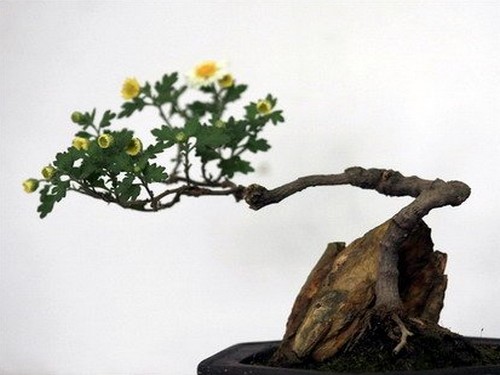
1. Making a cascade-style bonsai:
Using the chrysanthemum seedling's natural upward habit, bend the seedling into a drooping shape, and use fine wire or tying string to fix the main stem of the seedling beside the wall of the pot. In autumn, when the flower buds are about to open, transfer it to a shallow pot, remove the shaping wire or tying string, and spread some moss on the surface of the pot. In this way, an elegant cascade-style chrysanthemum bonsai is presented before your eyes.
2. Making a rock-clinging chrysanthemum bonsai:
First find a well-shaped rock with distinct layers and an uneven, picturesque arrangement. In May, move the grown chrysanthemum seedlings onto the rock, mainly attaching the root system to the rock, then place them together in a large clay pot to grow. When the flower buds are about to bloom in autumn, transplant them into a purple clay (zisha) pot or porcelain pot of suitable size and depth. The rock-clinging chrysanthemum bonsai combines the ruggedness of the rock with the delicate beauty of the chrysanthemum, each enhancing the other.
3. Making a wood-clinging chrysanthemum bonsai:
Choose a vigorous, aged, plain dead tree stump, and carve a groove about 2-3 cm wide in the back of the wood. In early summer, take the plant out of the clay pot, place the branches and trunk into the groove already carved in the back of the dead stump, fix them with wire or rope, then plant them in a larger clay pot for care. In autumn, move them into a purple clay (zisha) pot. The decayed, mottled, ancient and unusual tree stump and the small delicate chrysanthemum set each other off, with the chrysanthemum's abundant flowers and lush leaves complementing the withered old stump.
4. Making a chrysanthemum-and-rock composition bonsai:
Choose a rectangular or oval purple clay (zisha) pot, plant chrysanthemums on one side or both sides, but do not plant them in the middle of the pot, and pair them with suitable rocks, in a form like the “chrysanthemum and rock” composition in traditional Chinese painting.
Although there are methods to follow in making chrysanthemum bonsai, no matter which form of chrysanthemum bonsai it is, it should be a pleasing organic whole. Of course, the most important thing is that you like it yourself.