Detailed Guide to Making a Chinese Hackberry Bonsai, Easy to Understand at a Glance
Chinese hackberry (Celtis sinensis) is produced in the Huai River basin and south of the Qinling Mountains, extending south to Guangdong, Guangxi and other provinces and regions, and is a subtropical tree species. It mostly grows scattered in plains and low mountain areas. It likes light and is suited to a warm, humid climate, and thrives in fertile, flat land. It is not demanding about soil, has a certain tolerance for drought, and also tolerates waterlogging and poor, thin soil, with strong adaptability.
Collecting from the wild:
Chinese hackberry is commonly found growing wild along the valleys of hills and low mountains in the Yangtze River basin and areas to its south. You can collect old sprouting stumps with ancient, unusual postures that have been cut back for many years, and carry out "raising the" [cultivating the raw material]. After pruning, root development is promoted and new branches sprout, then the shape is cultivated; after 1 to 2 years, it is potted and worked on, and a vigorous, antique-looking Chinese hackberry bonsai can be made in a relatively short period.
Potting process:
1. Choosing a pot: Chinese hackberry bonsai is noted for its antique elegance, so purple clay pottery pots or glazed pottery pots are suitable, and the pot shape is best rectangular, square or oval, depending on the tree's form. Because Chinese hackberry has dense foliage, deep green leaf color, and grayish-brown, rough bark, pot colors of light yellow or ocher brown are best, playing a contrasting and setting-off role.
2. Soil: Chinese hackberry is not choosy about soil and has strong adaptability, but it grows better in fertile, loose, well-drained sandy loam. For bonsai cultivation, a growing medium made by mixing garden soil with sand or rice husk ash is generally used.
3. Planting: It is best done after autumn or before spring bud break. When planting, the root system should be properly pruned and tidied, cutting off overly long main roots and keeping more lateral roots and fibrous roots, then mounding loose, fertile soil around them, and at the same time properly thinning the branches and leaves. If planted in a medium-shallow pot, the roots must be fixed to the bottom of the pot with metal wire to prevent them from toppling.
Shaping techniques:
1. Working: The shaping of Chinese hackberry mostly uses the method of coarse wiring and fine pruning, while the Lingnan-school large-tree style working completely uses the pruning method, imitating Lingnan painting techniques, paying attention to pruning skills, retaining branches and truncating the trunk, and emphasizing the overall compositional effect. A stump specimen worked into shape can maintain a beautiful form whether in lush leaf or in the leafless winter state.
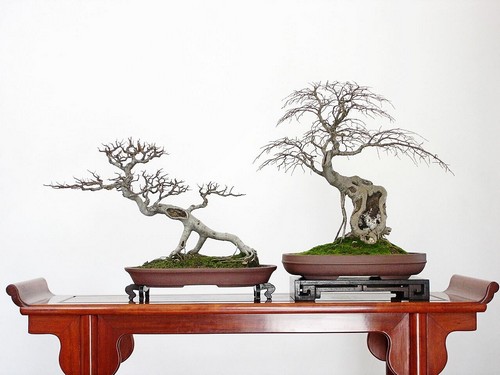
2. Tree form: Chinese hackberry bonsai is suitable for being made into forms such as straight-trunk style, slanting-trunk style, curved-trunk style, lying-trunk style or root-on-rock style. The branches and leaves can be wired into pads or pruned into steamed-bun-shaped round pads, and can also be worked into a natural tree shape.