How to make a cherry blossom bonsai, a detailed step-by-step guide
Cherry blossoms have bright, vivid colors and lush, vigorous branches and leaves. They are an important flowering tree species for early spring and are often used for garden viewing. They can be planted in groups, and can also be planted on hillsides, in courtyards, along roadsides, and in front of buildings. When in full bloom, the flowers are abundant and gorgeous, the whole tree is splendid, like clouds and rosy clouds, extremely spectacular. They can be planted in large patches to create a “sea of flowers” landscape, can be dotted in green spaces in clusters of three or five to form brocade-like groups, and can also be planted alone to create the pictorial charm of “a single touch of red among a vast expanse of green.” Cherry blossoms can also be used as street trees along paths, as hedges, or to make bonsai.
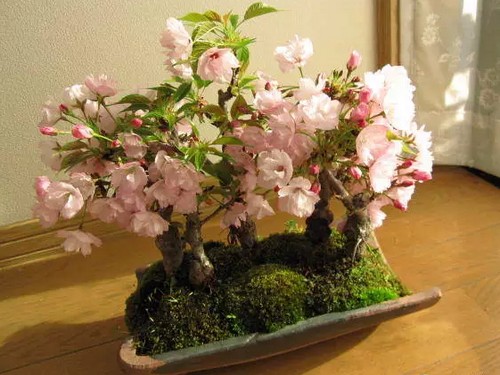
There are the following 2 quick methods:
(1) Directly potting for appreciation: Select cherry blossom trees in the nursery with a small, compact tree shape and beautiful form, and directly pot them for appreciation. For example, ‘Dwarf Weeping’ has branches that naturally droop, with a beautiful and unique tree shape, and can be appreciated after only slight trimming once potted; ‘Mikuruma-gaeshi’, ‘Shogetsu’, and others have small, compact tree shapes, beautiful flower forms, and bright flower colors, and can also be directly potted for appreciation.
(2) Transforming cherry blossom trees into cherry blossom bonsai. There are three sources of cherry blossom trees used for transformation into bonsai:
① Cherry blossom trees in courtyards that are weak in growth; their trunks are mostly rugged and ancient-looking, making them top-grade material for making cherry blossom bonsai.
② Cherry blossom trees with poor tree shapes that are unsuitable for courtyard placement.
③ Cherry blossom trees whose trunks have died but whose root crowns are still alive can also be used to make cherry blossom bonsai. We use the method of top grafting to change the head for transformation. The cherry blossom tree can be reshaped first and then top-grafted; shaping generally adopts a combination of pruning and binding. Top grafting to change the head of cherry blossoms is generally carried out in early spring before cherry blossoms sprout (in Wuhan, generally in mid-to-late March), with the specific time based on the phenology of that year. The scions can also be cut off first and stored refrigerated in a refrigerator, then grafted when the rootstock sprouts; the survival rate is also very high. When using the cut grafting method for top grafting to change the head of cherry blossoms, the technical points to note are:
a. Cutting method for scion and rootstock. Cut a long slanted surface about 2—3cm long at 1cm below the scion bud, and cut a short surface within 1cm long on the opposite side of the long surface. Cut the scion into small sections 5—6cm long with 2 to 4 buds. On the cherry blossom tree to be transformed, choose a branch with a thickness similar to the scion as the rootstock, cut the short-cut end of the rootstock flat, hold the rootstock with the left hand, and with the right hand make a straight cut at the edge of the xylem of the rootstock (at 1/4 to 1/3 of the rootstock cross-section); the length and width of the rootstock cut should correspond to the long surface of the scion.
b. Insertion. Insert the scion with its long slanted surface facing the rootstock, align the cambium on one side, and wrap the bark at the rootstock cut around the outside of the scion.
c. Binding. Bind with a plastic film strip about 1cm wide (preferably with a certain elasticity), and the film strip must be pulled tight when binding.
d. Bag covering. After grafting, cover the grafted seedling above the roots with a small white transparent plastic bag, and tie the opening well with packing rope; this can play a role in moisture retention. The size of the small plastic cover bag is about 12cm×8cm. We can graft cherry blossom varieties with similar flowering periods onto one pot of cherry blossoms, producing a ten-variety brocade cherry blossom bonsai with two kinds of flowers in one pot, or multiple flowers in one pot.