A Detailed Guide to Making a Buddha Belly Bamboo Bonsai
Since ancient times, scholars and refined gentlemen have loved bamboo, regarding it as having the bearing of an elegant gentleman. Indeed, its features of being sturdy and upright, handsome and graceful, not withering through frost and snow, and staying evergreen through all four seasons are truly extraordinary. If you also love bamboo but do not have a rural bamboo grove surrounding you, then make it into a bonsai and invite it into your home.
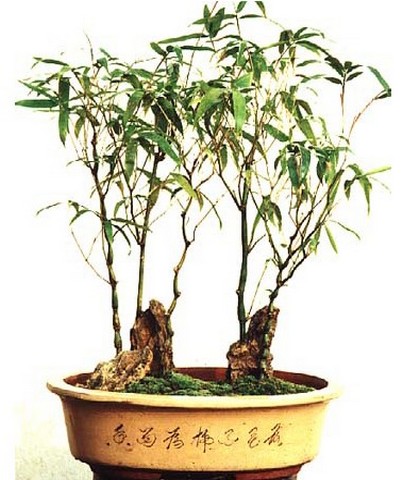
At this point, Buddha Belly Bamboo (Bambusa ventricosa) is a very good choice. This bamboo plant is relatively short, with young culms green and older culms orange-yellow. What makes Buddha Belly Bamboo different from ordinary bamboo is that its nodes are relatively thin, and the internodes are short and swollen, resembling the belly of Maitreya Buddha, and also like stacked arhats. Therefore, it is also called Arhat Bamboo and Dense-node Bamboo.
I. Styling and Pot Selection
When making a bonsai with Buddha Belly Bamboo, a forest style is mostly used to express the natural charm of a bamboo grove, but some also use one or two Buddha Belly Bamboo plants to make a bonsai. If two Buddha Belly Bamboo plants are planted in one pot, they should be one large and one small, one thick and one thin, one tall and one short, one straight and one slanted. The upright plant should generally be tall, large, and thick, while the slanted plant should generally be small, thin, and short, with the former as the main subject and the latter as the auxiliary. If the two plants are similar in size and both are upright, such a bonsai has poorer appeal. When making a forest-style Buddha Belly Bamboo bonsai, according to the size of the pot, generally 5, 7, or 9 plants are planted together in one pot. Taking 5 plants as an example, according to plant size, number them No. 1, 2, 3, 4, and 5. When making it, No. 1, 3, and 4 are often used as one group as the main body of the bonsai; No. 2 and 5 form another group as the secondary body of the bonsai, playing a supporting role, and an appropriate distance should be left between the two groups.
For a forest-style Buddha Belly Bamboo bonsai, it is best to use a relatively shallow rectangular or oval purple clay pot, followed by a glazed pottery pot. If some beautifully crafted panda ornaments of appropriate size proportion are placed in it, the bonsai will be even more poetic and picturesque. If 2-3 Buddha Belly Bamboo plants of differing heights are planted in the pot, and then exquisite rocks are placed in appropriate positions in the pot, it becomes a beautifully shaped three-dimensional Chinese painting - "Bamboo and Rock Painting."
II. Planting and Propagation
For the propagation, repotting, and planting of Buddha Belly Bamboo, May or September is suitable. Propagation often uses the division method, that is, taking the plant out of the pot, removing about 1/2 of the old soil around the roots with a bamboo strip, finding the thick roots connecting the plants, cutting them off, and then dividing and planting. When planting, carry as much old soil as possible to increase the survival rate. In combination with division and repotting, old roots, overly long roots, and dead roots should be cut off, and at the same time upright branches, drooping branches, and overly dense branches should be pruned to reduce water evaporation from the plant, help it survive, and make the plant shape more beautiful. Buddha Belly Bamboo prefers loose, relatively fertile, well-drained acidic sandy soil. A mixture mainly of humus soil with a small amount of sandy soil mixed evenly can be used.
III. Materials & Tools:
Materials: Buddha Belly Bamboo, a mixture of humus soil and sandy soil (bamboo garden soil also works), a container
Tools: scissors, a small shovel, etc.
Steps:
1. Choose a relatively shallow rectangular or oval purple clay pot as the container; glazed pottery pot material is also acceptable.
2. First fill the pot with some mixed soil of humus soil and sandy soil (bamboo garden soil also works).
3. Choose 5 Buddha Belly Bamboo plants of differing heights. When digging them out of the soil, carry as much old soil as possible to increase the survival rate. At the same time, cut off the old roots, overly long roots, and dead roots of the 5 bamboo plants, and also prune overly dense branches to reduce water evaporation from the plants and help them survive.
4. Divide the 5 Buddha Belly Bamboo plants of differing heights into two groups, with the 3 taller plants in the center of the container as the main body, and the 2 shorter plants on the sides as a foil, then plant them in the pot. Moss, small stones, etc. can be laid on the soil as landscape features.
5. After the newly planted bonsai is watered thoroughly, place it in a shaded place for about 10 days of care, then place it in a half-shade, half-sun place for 5 days of care, and then place it in a sunny, well-ventilated, warm, and humid environment for careful maintenance.
Tips:
1. Buddha Belly Bamboo likes moisture, so water it frequently to keep the soil moist, but there should be no standing water in the pot.
2. Buddha Belly Bamboo grows relatively quickly, so branches not needed for the shape should be pruned promptly to avoid consuming nutrients.