How to make a lilac bonsai, step-by-step guide
Lilac is a shrub or small tree, up to 5 m tall; bark grayish-brown or gray. Branchlets, inflorescence rachis, pedicels, bracts, calyx, both surfaces of young leaves, and petioles are all hairless but densely covered with glandular hairs. Branchlets are relatively thick, with sparsely scattered lenticels. Leaves are leathery or thickly papery, ovate to reniform; the panicle is upright, emerging from lateral buds, nearly spherical or oblong, flowering from April to May.
The distribution of lilac is centered on the Qinling Mountains, reaching north to Heilongjiang, Jilin, Liaoning, Inner Mongolia, Hebei, Shandong, Shaanxi, Gansu, and Sichuan; it also occurs in Korea, and south to Yunnan and Tibet. It is widely cultivated in temperate regions around the world. It is produced in Northeast China, North China, Northwest China (except -) and as far southwest as northwestern Sichuan (Songpan, Nanping). It grows on mountain slopes in thickets, by streams in mountain gullies, along valley roadsides, and by the water on flats, at an altitude of 300-2400 m. It is commonly cultivated in gardens north of the Yangtze River.
(1) Material collection and propagation measures
Artificial propagation: Lilac can be propagated by sowing, grafting, layering, division, and other methods. Sowing can produce more seedlings, but it easily causes variation and makes it difficult to maintain the characteristics of superior varieties, so it is mostly not used. Grafting is most suitable for cultivating bonsai material; the root stocks of glossy privet (Ligustrum lucidum), Chinese privet (Ligustrum sinense), and fringetree (Chionanthus retusus) can be used as graft rootstocks; using young shoots of young lilac trees as scions and cut-grafting them onto the stock branches and trunks makes survival relatively easy. Budding can also be done during the plum rain season, grafting lilac buds onto glossy privet or Chinese privet branches and trunks, mostly using T-shaped bud pieces for patch budding, which also survives easily. However, after the graft takes, shoots sprouting from the rootstock must be cut off at any time. The cutting method is carried out in mid-June, using softwood cuttings inserted into sandy loam, with proper shading and keeping the bed soil moist, giving a relatively high survival rate.
(2) Potting process
Pot selection: For lilac bonsai, medium-deep pottery pots or glazed pottery pots are suitable, either square or round. Pot color is best in light blue or light yellow, which can set off and contrast with purple and white flowers.
Soil: Lilac prefers loose, fertile, moist, and well-drained soil. For potting soil, humus soil or garden soil mixed with an appropriate amount of sandy soil can be used; avoid heavy, sticky, and wet soil, and do not use too much fertilizer.
Planting: Successfully grafted lilac plants can be potted in February to March in spring. When planting, trim the root system, keep more fibrous roots, let the roots spread in the pot, and firm the soil so that the roots and soil are in close contact. The covering soil should be 2-3 cm below the pot rim; water thoroughly, place in shade for ten days, then move to a spot with sufficient light.
(3) Fertilization:
Generally, do not fertilize or apply only a small amount of fertilizer. Never apply too much fertilizer, otherwise it will cause excessive vegetative growth, which in turn affects flower bud formation and, on the contrary, reduces flowering. However, after flowering, some phosphorus, potassium, and nitrogen fertilizers should be applied.
(4) Shaping and pruning
Processing: Lilac branches and leaves are opposite; for shaping, they can be trained into curved-branch form, weeping-branch form, or slanting-trunk form, and the branches and leaves can be pruned into layers. The roots of grafted old-stump seedlings can be made into a connected-root form or exposed-root form. When planting 3-4 year old large seedlings, the aboveground branches and trunks should be heavily pruned, generally cutting the trunk at 30 cm above the ground, and in the second year they can bloom abundantly. Pruning is generally carried out before bud break in spring, mainly removing thin and weak branches and overly dense branches, while reasonably retaining good renewal branches. After flowering, residual flower spikes should be cut off.
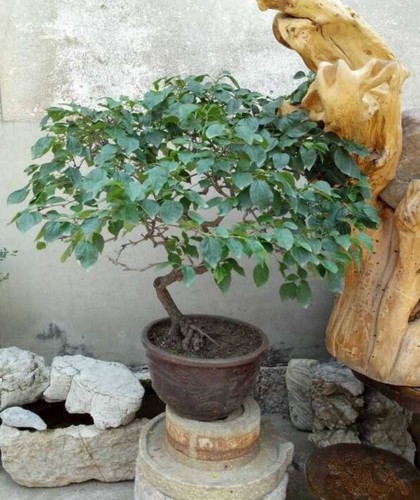
Tree form: Lilac bonsai can be made into straight-trunk form, slanting-trunk form, or curved-trunk form, and can also be made into a regular zigzag form, with the trunk curved and branches and leaves distributed on the left and right sides of the trunk, spreading flat and slightly drooping, giving the tree an elegant shape; when in full bloom, the branches are full of purple inflorescences, very beautiful.