What are the precautions for making bonsai from mountain-collected stumps?
What does "mountain-collected stump" mean? It refers to a plant that originally grew on a mountain being transplanted by humans into a similar artificial environment. So what should be noted during the process of making bonsai from mountain-collected stumps? Precautions for making bonsai from mountain-collected stumps:
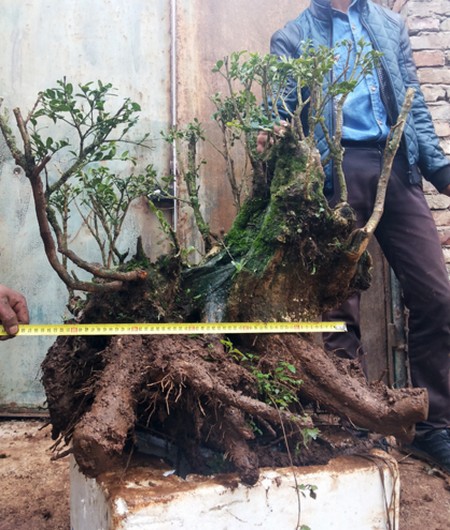
1. Do not collect stumps blindly. Many people always want to own many bonsai so they can enjoy them at any time, satisfying their “hunger” and quenching their “thirst.” But when first learning to make them, because their appreciation ability is insufficient, they want every stump they see when collecting in the mountains and fields, carrying out “carpet-style” digging, which both wastes resources and damages the ecology. When buying at markets, they also do not distinguish good from bad or superior from inferior, and buy in large quantities. As a result, most are low-grade, coarse pieces, wasting time, effort and money. Therefore, although beginners' eagerness to obtain stumps is understandable, they must have guidance from an experienced person to avoid getting half the result with twice the effort.
2. Do not care for stumps carelessly. The ancients said: “Success comes from thought, ruin comes from carelessness.” The same is true for caring for stumps. Stump care requires patience and carefulness, and even more requires understanding plant growth characteristics and soil structure as well as knowledge of water and fertilizer application and pest and disease control. When caring for them:
First, do not handle the stump carelessly. Each stump must be carefully pruned of branches and roots according to one's own styling ideas, and only after the wounds are treated can it be planted and buried in soil; otherwise it is not conducive to the stump's survival.
Second, do not prepare the soil carelessly. Soil is an important factor in whether a stump lives and grows well. If the soil is prepared well, there is greater hope that the stump will survive.
Third, do not apply water and fertilizer carelessly. Plant growth cannot do without fertilizer and water, but fertilizer should be applied lightly and frequently, and watering should be timely and appropriate. If large amounts of water and fertilizer are applied hastily, the stump cannot absorb them, which will cause waterlogging and root rot or fertilizer damage, and its survival will also be in danger.
Fourth, do not deal with pests and diseases carelessly. Many pests and diseases can endanger a plant's life within a few days, so they must not be treated lightly. Timely discovery and timely prevention and control must be achieved.
Fifth, do not handle the stump carelessly. When a stump is planted in the ground or in a large pot, you must wait until its root system is well developed and it has completely survived before repotting and changing the soil in a suitable season and suitable weather. Do not bury it in the ground one moment and then, in eager impatience, pot it up for display, moving it here and there; even a live stump will become a dead stump.
3. Do not rush the styling. Personally creating a work with a unique style is undoubtedly the most exciting thing, but do not rush.
First, do not rush styling when care has not been adequate. The branches of a stump must grow to a certain robust degree and gradually form transition branches with the trunk before they can be pruned and styled. Never judge only by length and not by robustness. When the branches grow to a certain length, do not bind and hang them in a “twisted doughnut style.” On the surface it may appear to have a certain shape, but on closer inspection it “lacks maturity,” especially for deciduous plants; when viewed in winter, their defects become clearly apparent;
Second, do not style when considerations are not mature. A stump requires repeated deliberation before the styling plan can be determined. Beginners, because they have only half-understood styling techniques and are eager to act, go into battle blindly, and afterward keep making drastic corrections again and again, causing a stump to be moved and placed around repeatedly, delaying the time and opportunity for it to take shape.
It is recommended that beginners, when styling, first put forward their own views and then seek guidance from an experienced person. This not only avoids detours but also helps improve one's own artistic accomplishment.