How to Make a Weeping Willow-Style Bonsai from Tamarisk
Tamarisk, also known as Guanyin willow, also known as Xihe willow. Its trunk is not very large, with reddish stems and slender branches, and leaves as fine as silk threads, graceful and lovely. It flowers three times a year, with flower spikes 2 to 3 cun (about 6.7-10 cm) long, pink in color and shaped like smartweed flowers, hence it is also called three-spring willow. Its flowers open whenever it rains, and it is suitable for planting by water and beside ponds. If rain is coming, the tamarisk rises first to respond to it, so it is also called the rain master. Its leaves turn completely red after autumn and do not fall off under frost, and it is easy to propagate by cuttings in spring.
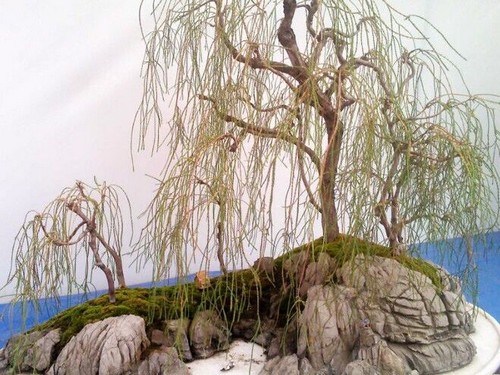
Willow branches droop and sway in the wind, making it a plant full of poetic and picturesque charm, and there are countless poems praising willows through the ages. Many people also want to use the art form of bonsai to express the graceful and charming elegance of weeping willows, but because willow branches in nature are long and their leaves are large, the effect of using them to make bonsai is not ideal. Thus some bonsai artists use other tree species with small leaves and branches that either droop naturally or can be made to droop naturally after artificial processing to replace willow in making weeping willow-style bonsai. Commonly used species include Chinese wolfberry, serissa, small-leaved privet, winter jasmine, tamarisk, and others. Among them, tamarisk gives the best artistic effect.
Below, let us take tamarisk as an example to discuss the making of weeping willow-style bonsai.
Willows in nature mostly grow in plains with sufficient soil moisture or by water such as riverbanks and lakesides, so the roots or trunks of willows are not as twisted and vigorous as trees growing on mountains, nor do they have forms uncommon in nature such as root-on-rock style or cascade style in their growth posture. Therefore, when selecting stumps, these factors should be considered so that the finished bonsai conforms to natural laws and achieves the artistic effect of "coming from nature, yet surpassing nature."
After the stump has been cultivated and survived, shaping can be carried out in May to June when the branches have not yet lignified and have the best flexibility. The style can be chosen according to the different stumps, using formal upright style, slanting style, waterside style, wind-swept style, lying trunk style, double trunk style, and so on. The method may use metal wire to wrap and bend the branches so that they droop; or a ring of metal wire may be wrapped around the flowerpot, and then the branches may be fixed on the metal ring at different heights and in a well-arranged manner, and made to droop by pulling; or weights of varying heaviness may be hung from the branches so that they droop through the action of gravity.
In addition, when the branches have not yet lignified, external force may be applied with the fingers from the base of the branch to the tip to make the branches bend and droop. This method should be repeated, bending while increasing pressure; some people also select one or several bending points on the middle-upper part of the branch and gently break them by 1/3 with the hand so that the branches bend and droop. With this method, after shaping, the broken branches are firm and powerful, while the new branches are round and smooth, and the whole work combines hardness and softness, with a unique effect. The above methods can be used individually or in combination. Whichever method is used, there must be a natural transition from thick to thin from the base of the tree to the trunk, main branches, side branches, and fine branches.
The making of weeping willow-style bonsai from other tree species is largely the same as with tamarisk, and distinctive weeping willow-style bonsai can be made according to the different characteristics and habits of each species.
The shaping of tamarisk bonsai should be carried out in spring, and pruning in winter must be avoided, otherwise it will cause "branch dieback," making a complete bonsai lose necessary leaves and branches, causing regret and seriously affecting its ornamental value. A finished tamarisk bonsai should be kept during the growing period in a semi-shaded place with circulating air, maintaining moisture in the pot soil and air, so as to avoid yellowing and falling of leaves caused by drought, while long-term water accumulation in the pot soil will cause root rot.
Under the condition of ensuring that the pot soil does not accumulate water, frequently spraying water on the plant is very beneficial to its growth; its leaves are emerald green, and the new branches are soft, charming, and very beautiful. Apply a decomposed dilute liquid fertilizer once every 7 to 10 days to provide sufficient nutrients and make the plant grow vigorously; the fertilizer solution should be light rather than concentrated, otherwise it will cause excessive growth of branches and leaves and affect its ornamental value.
Tamarisk grows rapidly and has strong sprouting ability. In order to maintain the beauty of the tree shape, branches that affect the styling can be cut off at any time during the growing period. In winter, place it indoors in a cold room for overwintering, keeping the pot soil from freezing and from becoming excessively dry. In areas south of the Yellow River, it can also overwinter outdoors in a wind-sheltered, sunny place, keeping the soil slightly moist to prevent branch dieback caused by "dry freezing," which in severe cases may even cause the whole plant to die. Repot once every spring; the pot soil can be a mixed soil of 1 part sand soil and 1 part garden soil. If several rounds of decomposed liquid fertilizer are applied or a small amount of plant ash is mixed in, the effect will be even better.