Detailed Explanation of the Methods and Steps for Making a Tamarisk Bonsai
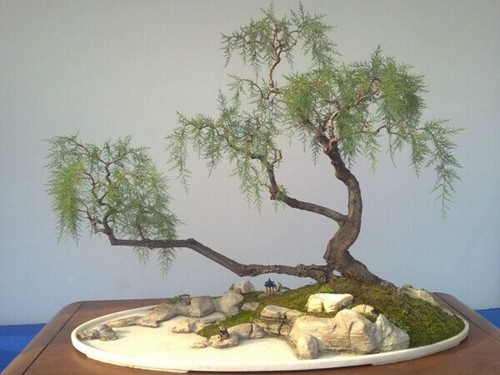
Tamarisk has fine branches and small leaves, with drooping branches that are graceful and charming, resembling a weeping willow; its trunk is like iron, ancient and peculiar, possessing the quality of pine and cypress; it blooms three times a year with a long flowering period, and the pink flowers cover the branches, making it even more enchanting; its roots are like roaming dragons, with wonderful forms. Whether viewing roots, trunks, leaves, or enjoying flowers, it has advantages unmatched by other tree species and is an excellent tree species for making bonsai.
I. Material Collection and Cultivation Measures
Artificial propagation: Mainly by cuttings. Both old and young branches can be used for cuttings, and there are spring cuttings and autumn cuttings. Spring cuttings are done in February to March, using healthy branches or seedling stems of more than one year old as cuttings, 15-20 cm long, inserted directly into the seedbed, with the cuttings exposed 3-5 cm above the soil surface. By January to May they will root and grow, with a survival rate of over 95%. With occasional watering and fertilization management, the current-year seedlings can reach over 1 m in height. Autumn cuttings are done in September to October, using shoots that grew in the current year as cuttings, with the same method as spring cuttings. The survival rate is also very high, and seedlings form very easily. In addition, methods such as root division and layering can also be used for propagation.
Collection from mountains and wilds: Tamarisk has strong adaptability. Root suckers are commonly found by watersides and streams in mountains and wilds. Old stumps that have been cut back for many years can be selected, dug up, potted, and shaped. In a relatively short period, an elegant tamarisk bonsai with soft, draping branches can be produced.
II. Light and Growth
Tamarisk prefers strong light and a well-ventilated environment. During growth, except when using light-control methods to make branches naturally droop when creating weeping-style shapes, it should be placed in a location with ample light. Some larger branches, due to insufficient light and poor ventilation, may easily develop dead branches the following year, which will seriously affect the crown shape.
III. Pruning, Shaping, and Potting
Time: Although tamarisk is easy to keep alive and can be planted in all four seasons, potting too late affects root development. The branches themselves are poorly nourished and individual branches may easily die, so the best time for potting is January to March and October to December. If potting or repotting during the plum rain season, try to damage the roots as little as possible and keep more of the original soil.
Pot selection: Tamarisk generally should use purple clay ceramic pots or glazed ceramic pots, preferably in a relatively shallow rectangular or oval shape. If the branches hang down, the pot can be placed on a stand; deep cylindrical pots are not suitable.
Soil: Tamarisk is not strict about soil quality. For potting, it is best to use fertile, loose garden soil or river mud, mixed with an appropriate amount of sandy soil.
Planting: It is best to pot and plant before spring budding or after leaf fall in autumn. When planting, most branches can be cut off, retaining the necessary trunk and branches to let them sprout and grow, which is beneficial for shaping.
Processing: Tamarisk is suitable for processing by combining pruning and wiring. Generally, first appropriately wire and shorten the main branches and trunk, then cut away the overly dense fine branches, and bend all the rest into a drooping form, but they should not be cut short, otherwise the tree shape will be very unnatural. Wiring is best done before the new shoots are fully lignified, as it is easier to set the shape. Palm fiber is better for wiring, and it must be removed by the beginning of autumn to avoid "wire bite." If a second flush of new shoots grows, wiring can be done again in August to direct the new shoots' growth.
Tree shape: Tamarisk is suitable for shaping by imitating the posture of willow trees in nature. The main trunk can generally be made into slanting-trunk style, double-trunk style, forest style, curved-trunk style, lying-trunk style, and cascade style, etc. The branches are best made into weeping-branch style, but not all should hang down. The main thick branches must be upward, while all the other fine branches hang down. In this way, the tree shape has strength, rather than merely bending and bowing. It can also be made into wind-swept style, with branches drifting to one side, giving the artistic conception of "riverside willows in a swift wind."
In shaping and pruning, tamarisk is generally more commonly styled in the weeping-branch form. When making a natural weeping-branch form, the difficulty lies in creating the weeping branches. This is because, under natural growing conditions, the new branches of tamarisk most easily grow upward. Meanwhile, small branches and side branches most easily droop. When making a weeping-branch bonsai shape, the branches cannot be allowed to grow freely. The position, number, density, length, thickness, layered variation, and overall outline of the drooping branches must be determined according to the layout requirements. If the methods of "early branch selection," "shade treatment," "branch pulling," and "thinning side branches" can be correctly applied, good results can be achieved.
1. Early branch selection means that when the new shoots sent out by tamarisk in early spring grow to 10-15 cm, branch selection should be carried out. First, the slightly weaker side branches and the small lower branches should be selected as the weeping branches. These branches droop most easily and are slender and soft. Strong branches should be removed, because strong branches do not droop easily and lack a soft posture. If a certain local branch or trunk has few new shoots, the new shoots can be pinched back to encourage the growth of side branches.
2. Shade treatment means that during the growing period of tamarisk, branches tend to grow upward under strong light, so appropriate shading should be provided, with semi-shade being best. After a period of shading, most branches can naturally droop and become soft.
3. Branch pulling means that when a certain branch does not droop easily or has a poor drooping angle, metal wire can be used for wrapping and binding so that it meets the production requirements.
4. "Thinning side branches" means that when side branches grow too vigorously or there are too many weeping branches and congestion appears, pruning and thinning should be carried out. Crisscrossing, messy branches should also be adjusted and smoothed into order.
When tamarisk is used for other bonsai shapes, it is generally done when the branches are lignified or semi-lignified, so that they have more natural growth stages. Avoid doing this after rain or in the morning, when the branches are more brittle and easily broken. When making pine-and-cypress-style shapes, apart from pruning that must be done before exhibitions, excessive pruning is generally not advisable.