Detailed Guide to Making a Boxwood Bonsai
Littleleaf boxwood is an evergreen shrub or small tree of the genus Buxus in the order Euphorbiales. The trunk is grayish-white and smooth, the branches are densely borne and four-angled. The leaves are opposite, leathery, entire, elliptical or obovate, with a rounded or slightly notched tip, bright green on the surface and yellow-green on the underside. The flowers are clustered in the leaf axils or at the branch tips, opening from April to May, and are yellow-green. The main producing areas are Anhui, Zhejiang, Jiangxi and Hubei in China. With its graceful tree form, it is an important tree species for hedges and landscaping, and also a precious species for making bonsai.
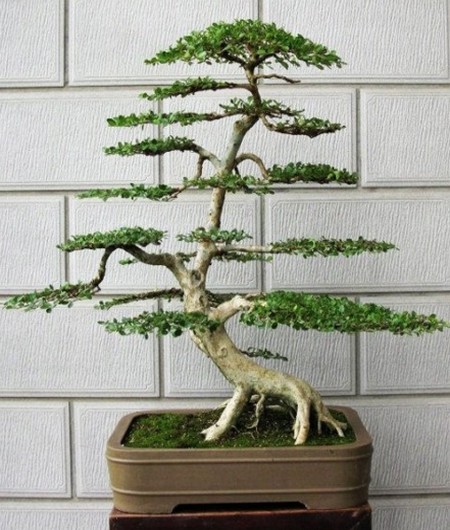
Obtaining material:
For bonsai material, one option is to use propagation by seed or cuttings, but this takes a long time to grow and it is very difficult to obtain good material with gnarled, exposed roots and a vigorous, ancient, unusual character. The second option is to dig up old stumps. Digging up old stumps is best done in summer, followed by spring and autumn, and is worst in winter. After collection, the stump material can be wrapped in plastic bags to keep the roots moist. When planting, remove the downward-growing main root and cut off most of the leaves to prevent water loss and ensure survival. The material can first be grown out in open ground, or it can be potted directly, but it must be cultivated for more than two years before shaping can begin.
Choosing a pot:
For pot selection, Yixing purple clay pots or light-colored glazed ceramic pots can be used. The shape and size of the pot can be determined by the size of the stump and the style of the design. In principle, cascade style is best suited to square or round tall cylinder pots, while slanting trunk, curved trunk, and forest styles are best suited to round, oval, or rectangular pots.
Soil:
Potting soil: littleleaf boxwood likes fertile sandy loam. For potting soil, fertile, loose sandy loam with good aeration and drainage is best. A mix of 40% furnace slag, 40% leaf mold or garden soil, and 20% river sand can also be used.
Potting up:
The best time for potting up is between spring and summer. When planting, cut off overly long and dense roots, and revise the root system as needed for the design so that the roots spread naturally in the pot. The planting depth should not be too deep. After covering with soil and watering thoroughly, place it in semi-shade, keep the potting soil moist, and spray the leaves with water frequently. After about 30 days, once the plant has grown, it can be moved to normal care.
Water and fertilizer:
Littleleaf boxwood likes moisture and needs frequent watering. From May to August is the vigorous growth period of boxwood, and several applications of thin, fully decomposed cake fertilizer can be made along with watering.
Pruning:
Always pay attention to pruning vigorous shoots, overlapping branches, and excess branches that affect the tree shape. Remove the fruit set by littleleaf boxwood promptly to avoid consuming nutrients.
Shaping:
Shaping should be based on the plant's basic tree form, following its natural tendency to create an artistic design. Shaping techniques can include pruning and wiring, but wiring is best done in summer and autumn, when the branches are more flexible and easy to bend; pruning is best done in spring. Although littleleaf boxwood has strong sprouting ability, "without leaves there is no growth," so whether for shaping or routine pruning, for branches that are not in the right position, the method of "retaining leaves section by section, cutting back to force buds" can be used so that they gradually sprout lower down into the right positions. Do not blindly seek to achieve everything in one step.
Repotting:
For Chinese boxwood, repotting is generally done every 2 to 3 years for small and medium pots and every 5 years for large pots. Weak-growing plants should be repotted in time. Along with repotting, cut off some overly long and dense old roots, replace with fresh growing medium, and replant.