Detailed Guide to Making and Managing Red-Leaf Barberry Bonsai
Red-leaf barberry blooms with yellow flowers in spring and bears red berries in autumn; it is an ornamental shrub beautiful in leaf, flower and fruit alike. It is suitable for use in gardens as a flowering hedge, planted in groups at the corners of garden paths, edging large flower beds, or pruned into symmetrical spherical shapes for companion planting. It can also be dotted among rocks or beside ponds. It can also be made into bonsai; widely used in landscaping, it delivers excellent greening results and has a high transplant survival rate, making it deeply loved by people.
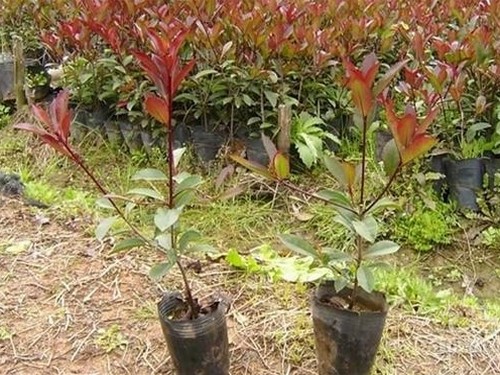
As long as you master the methods of making and managing it, you can create a fine red-leaf barberry bonsai. Nowadays more and more people value decorative container gardening, and the market for red-leaf barberry bonsai is viewed favorably; those who are interested can give it a try.
Choice of potting soil:
Ordinary garden soil mixed with sandy soil is enough. It is best to repot once every other year.
Propagation techniques:
Barberry propagation mainly uses cuttings, though division and sowing can also be used. Because barberry has strong adaptability, grows vigorously and is easy to manage, potted plants are usually divided or transplanted into pots in spring; if transplanted with a soil ball, recovery is even better. Red-leaf barberry has strong adaptability and is cold- and drought-tolerant. It likes bright light and a cool, moist environment, and also tolerates partial shade. It should be planted in well-drained sandy loam and is not demanding about water. Waterlogged soil during the seedling stage will cause root rot.
In midsummer it is best kept in a semi-shaded spot for care, while in other seasons it should receive plenty of light; watering should follow the principle of alternating dry and wet, and it should not be watered unless dry. Although this plant is fairly drought-tolerant, frequent drought is unfavorable to its growth; in hot, dry weather, spraying water to lower the temperature and raise humidity is very beneficial to its growth and development. Transplanting can be done in spring from February to February or in autumn from October to November, either bare-root or with a soil ball. During the growing season, apply a liquid fertilizer such as 20% cake fertilizer water once a month.
Suitable styles:
The red-leaf barberry plant is on the small side, so it is better suited to small and miniature bonsai. As for style, you can choose a single plant to work with, making it into a formal upright, twin-trunk, slanting trunk or semi-cascade style. You can also place multiple plants in one pot to make a forest-style bonsai. It can also be combined with other landscape bonsai as an accent.
Shaping and pruning:
It can be pruned into an artificial spherical shape, that is, heavily pruned while young to encourage new branches. Afterward, pruning to maintain the tree shape can be carried out. Plants that have been planted too densely should be re-pruned once every 3-5 years to achieve the goal of renewal and rejuvenation. Every year from the start of winter to early spring, the plant needs appropriate tidying: prune overly dense branches, diseased and pest-damaged branches, leggy branches and overly weak branches, and keep the branches evenly distributed to form a spherical shape. Because red-leaf barberry has strong sprouting ability and tolerates pruning, it is often grown as a hedge, and is also suitable for small or miniature bonsai, mainly in formal upright or slanting trunk style, or made into forest style.
The red-leaf barberry plant has strong sprouting ability and tolerates pruning. It can also be trained by wiring. Note, however, that although the branches are fairly flexible, they bear thorns, so when wiring and pruning for shaping, do not let them prick your fingers. In addition, when shaping, be sure to note: it should be both sparse and dense as appropriate, with distinct layers, so that it has greater ornamental effect.
Cutting of scion material:
Cut red-leaf barberry material into 12-15 cm long cuttings with robust terminal buds. To improve the cutting survival rate: after cutting, bundle 50 cuttings together and soak the basal 2-3 cm in a 0.01% solution of indolebutyric acid or ABT rooting powder for 30-50 minutes. Insert the cuttings before 10 a.m. or after 4 p.m. the same day. Insert to a depth of 2-3 cm, with a plant-to-row spacing of 2.5 cm × 3 cm. Press lightly after inserting, and water as you go so that the cuttings are in close contact with the cutting medium.
Fertilizer and water management:
The 20 days after insertion are the key period for rooting; each misting should last for two full rotations of the boom. For the interval, on sunny days from 10 a.m. to 6 p.m. mist once every 2-3 minutes, and before 10 a.m. and after 6 p.m. mist once every 10 minutes. After 20 days the interval should be gradually increased; after 50 days the interval is 50 minutes; on cloudy days reduce the number of mistings, and do not mist at night. Fertilizing can supplement nutrients for the cuttings and improve their survival. From 20 days after insertion to late September, spray a mixture of 0.2% urea and 0.3% monopotassium phosphate once every 7-10 days. Use 0.5 kg of solution per square meter. Foliar fertilization should be done in the evening after misting has stopped. Also weed and control pests promptly, and carry out normal management.
Bonsai management:
A red-leaf barberry bonsai in the growing season needs to be placed outdoors in a spot with plenty of sunlight and good ventilation. Only with sufficient light will the leaf color be attractive. At the same time, fertilize regularly; about once every twenty days apply a dilute liquid fertilizer. March to April is the flowering period; during this time a little monopotassium phosphate solution can also be applied to the leaves.
Leaf management:
From the end of August to early September, the old leaves can be pruned appropriately. Spraying urea can stimulate new leaves; the new leaves are bright red and glossy, beautiful and striking. This will give the bonsai yet another look. Generally by the end of September the new leaves have grown out. If there is sunlight in winter, it can also be brought out for a few days at the right time.