Detailed Guide to the Methods and Techniques for Creating Chinese Juniper Bonsai
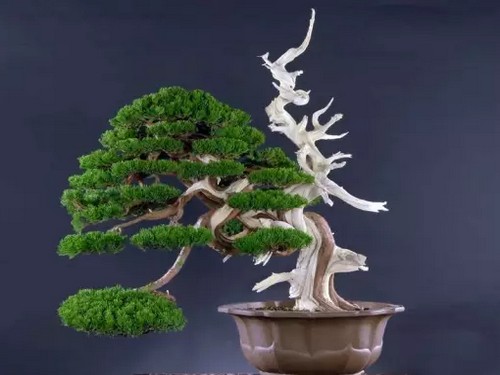
Chinese juniper bonsai has long been famous in bonsai circles at home and abroad for its old trunks and gnarled branches, fine dense foliage and elegant posture. Especially in Japanese bonsai exhibitions, shari (deadwood) trunks made from century-old junipers are commonly seen, with white deadwood and red bark alternating, resembling a roaming dragon, vigorous and antique, truly possessing an immortal's bearing, and can be called a superior product among bonsai. In the Taiwan, China potted plant community, besides Japanese lineage varieties, Tianpei Chinese juniper is also suitable for cultivation as potted plants and is used for this purpose, commonly known as Taiwan, China Chinese juniper. Its foliage has a firm clustered structure, emerald green color, and wood rich in resin; its red grain can rival the Japanese mountain-collected Itoigawa Chinese juniper, and it is very sturdy and durable, making it an excellent variety.
[Material Selection and Cultivation]
Artificial propagation: Chinese juniper is usually propagated by cuttings or layering. For cuttings, one-year-old tender branches are best, with cutting length of 10-15 cm; remove the small branches on the lower half and insert to a depth of 1B2; the seedbed should use leaf mold mixed with sandy soil, and should be fertile, loose and well-drained. After inserting, water thoroughly, and set up a shade frame at any time; roots will form after 2-3 months. The following spring, divide and transplant to cultivate large seedlings. Chinese juniper often grows prostrate on the ground, and adventitious roots develop accordingly, so it can also be propagated by layering. Grafting propagation using Hinoki cypress or Chinese arborvitae seedlings as rootstock also easily survives.
[Potting]
Pot selection: Chinese juniper is suitable for purple clay pottery pots, and large bonsai can also use carved stone pots. The pot shape is preferably medium-deep rectangular, oval, square, round, hexagonal, etc.; for cascade style, a deep cylindrical pot can be used.
Soil: Chinese juniper is suitable for fertile, loose neutral soil or calcareous soil. For potting, humus soil mixed with charcoal crumbs or sand is commonly used.
Planting: It is best done in spring from April to May, and autumn is also acceptable. When planting, pay attention to placing a tile over the drainage hole to keep it open for drainage. After potting, the first watering should be thorough, and thereafter water when slightly dry.
[Styling]
Technical processing: The styling and processing of Chinese juniper mainly uses wiring, with pruning as a supplement. Generally, metal wire wiring is more convenient, allowing free bending, smooth lines, and the branches and trunk can be twisted to display the elegant charm of an ancient juniper. When wiring, focus on shaping the main branches and trunk well; small branches can be wired or pruned.
Local branches and trunk of Chinese juniper can be made into dead branches and dead trunks, the so-called "shari". This imitates the phenomenon in nature where trees, after long-term attack by wind, rain, thunder and lightning, form some branches and trunks that are split and broken with bark peeled off, thereby producing an antique and peculiar effect. When making it, certain branches and trunks can first be selected (often using branches and trunks that were not originally needed), small branches and foliage removed, and the bark peeled off from the base, which can be shaved with a knife or peeled with fingers. The branch tips must be cut into a natural broken shape, striving not to reveal artificial traces. Finally, apply lime-sulfur mixture to the peeled branches and trunk to prevent decay. The placement of "shari" is very important; it plays a role in regulating density, solidity and emptiness, and increasing contrast and variation in the overall juniper styling, so it must be carefully considered. "Shari" can be at the top of the tree or in the middle of the branches and trunk, depending on the needs of the styling.
Tree form: Ancient junipers growing in nature are often gnarled and twisted; Chinese juniper can also be styled into curved-trunk style, followed by cascade style, slanting-trunk style and prostrate-trunk style. The trunk of the curved-trunk style must be winding and varied, and special attention must be paid to changes in the direction and degree of the curves. The trunks of cascade style, slanting-trunk style and prostrate-trunk style should also not be too straight, but should preferably have some curvature.
The branches and foliage of Chinese juniper should preferably be made into clustered forms, and can appropriately droop. In addition, local branches and trunk of Chinese juniper can also be made into "shari".