A detailed guide to the entire process of making boxwood bonsai, beginners can learn it too
Boxwood branches and trunks are grayish-white and smooth, with leaves as small as broad bean petals, thick and glossy, emerald green in all four seasons, and ornamental all year round. After pruning and wiring into cloud-layer forms, they are flat and thin as if shaved; or when accented with rocks, they become even more natural and exquisite. Boxwood bonsai has a graceful tree posture, leaves as small as broad bean petals, thick and glossy, evergreen through all four seasons, and can be enjoyed all year round. In Yang-style boxwood bonsai, the branches and leaves are pruned and trained into a “cloud-layer shape”, flat and thin as if shaved, then accented with rocks, elegant and beautiful as a painting.
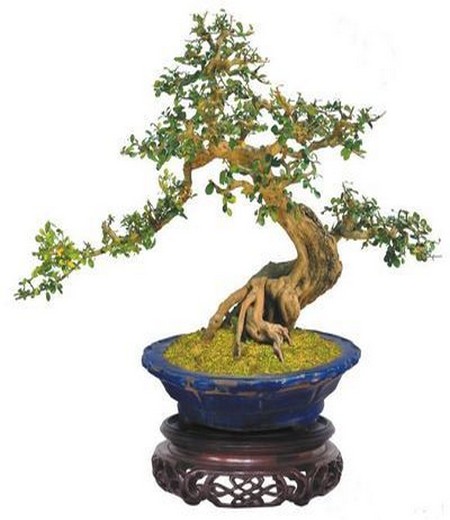
In spring, when boxwood's tender new leaves first emerge, the whole tree turns tender green, very pleasing to the eye. An ancient poem praising boxwood goes: a boxwood tree just a foot tall, with lush branches layered a thousandfold, leaves deep as an emerald garden, rooted ancient like a coiled dragon. Below is an introduction to the process of making boxwood bonsai:
Collecting from the wild
In subtropical mountainous areas, boxwood is mostly scattered under mixed forests or beside ditches at forest edges. In barren areas with exposed rock, boxwood grows short and small, with dense branches and leaves; when collected for potting and shaped, it often becomes a fine bonsai specimen. Fish-scale boxwood (Buxus sinica var. parvifolia) in the middle-upper elevations of 1300-1800 m in East China often grows in patches, forming evergreen thickets dominated by fish-scale boxwood. It also grows abundantly in mountain rock crevices. Its trunk form is thick and short, with dense branches and small leaves, making it most suitable for bonsai making.
However, fish-scale boxwood is a high-mountain tree species and requires a cool, moist climate and acidic sandy loam. When collecting wild stumps or seedlings, one should carry along plenty of mountain soil and original soil for cultivation, and spray water frequently. For topdressing, diluted cake fertilizer water mixed with a small amount of ferrous sulfate can be used. In summer, it should be placed in a shaded spot, or under tree shade; it is even better if the pot is placed on wet sand.
Potting process
Choosing a pot: Boxwood is suitable for purple clay pottery pots or glazed pottery pots. Pot shapes are mostly medium-deep rectangular or oval; for cascade style, a deep cylindrical pot is suitable. Pot color is best in purple or light yellow, to highlight the emerald green branches and leaves.
Soil: Boxwood prefers fertile, loose loam. It can adapt to slightly acidic soil or slightly alkaline soil, and can also grow in calcareous soil. For potting, matured garden soil or leaf mold mixed with an appropriate amount of rice husk ash can be used.
Planting: Generally carried out in spring before budding. When planting, properly prune overly long and overly dense roots, and do not let the root system become bent and cramped in the pot.
Shaping techniques
Processing: Wild-collected old boxwood stumps are generally cultivated for 1-2 years before processing begins; seedlings cultivated from a young age must wait 3-4 years before processing can begin.
For shaping, wiring is the main method, and coarse wiring with fine pruning can also be used. Boxwood branches and trunks are hard in texture and thin in bark, so metal wire should not be used for wiring; palm fiber is best. Wiring is mostly done in spring, while pruning can be done at any time.
Tree forms: Boxwood is suitable for slanting-trunk style, curved-trunk style, and cascade style, etc. In the traditional forms of “Yang-style” bonsai, boxwood branches and leaves are all made into “cloud layers” using the “fine wiring and fine pruning method”; while in “Su-style” bonsai, the “coarse wiring and fine pruning method” is used to create a “steamed bun” shape, each with its own characteristics. Boxwood has strong sprouting ability and is very tolerant of pruning, and can also be processed by pruning into a natural large-tree form. If a boxwood bonsai is paired with elegant stones, it becomes a “boxwood peak”, making the old-looking, small-tree boxwood grow beside the stone, its appearance even more natural and exquisite.