Detailed Explanation of the Key Techniques for Making Rose Bonsai
Roses are a very promising material for bonsai. The combination of rose flowers and bonsai has both the natural beauty of bonsai and the gorgeousness of rose flowers. A exquisitely made, vividly shaped rose bonsai is a highly impressive work of art. Rose flowers are brilliantly colorful and gracefully charming, and have long been known as the “Queen of Flowers.” Besides being grown in pots, planted in the ground for ornament, and used as cut flowers, roses can also be made into rose bonsai. Every morning when you wake up and see the roses blooming on the windowsill, your mood for the whole day improves greatly. Below, the editor shares with you the material selection and production of rose bonsai, hoping it will be helpful to you!
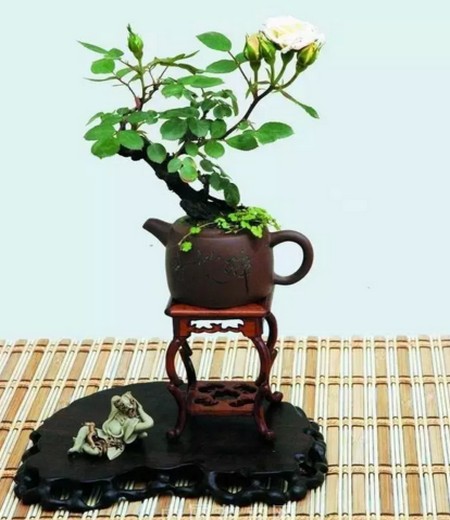
1. Selection of Roses
For roses used to make bonsai, the requirements are beautiful flowers, easy flowering, compact plant type, short internodes, small leaves, strong habit, strong sprouting ability, and tolerance of pruning. Flower color and flower type can be chosen according to personal preference. Because miniature roses have the characteristics of short plants, small and exquisite flowers, a large number of flowers, and a long flowering period, they are generally the first choice for grafting rose bonsai.
2. Selection of Rootstock
The old rose stumps that have grown for many years and have an antique and peculiar form, eliminated in landscaping, can also be used to make bonsai. They are generally transplanted in winter and spring. Because roses have well-developed main roots and few lateral roots, before planting, the overly long main roots should be shortened, and more lateral roots and fibrous roots should be retained. Planting should be deep, and it is best to bury all the roots in the soil to ensure survival. After planting, keep the soil moist but not waterlogged. After survival, remove new buds and tender branches not needed for the shape, and strengthen water and fertilizer management to promote robust branch growth.
3. Collecting Stumps: Every spring, go to hillsides and ditch edges to dig up Rosa multiflora stumps with peculiar stump shapes and naturally tapering tips. After the stumps are collected, the roots and trunks should be cut into place as much as possible, and they should be planted in plain sandy soil mixed with a little sawdust. Either pot planting or ground planting is acceptable. Cover the whole stump with a plastic bag, and after new buds grow 3cm-5cm, remove the plastic bag on a cloudy or rainy day. Then spray water on the trunk and leaves every morning and evening to ensure survival. In August, fertilization can begin, once every half month, preferably with cake fertilizer water. For those whose branches transition naturally, prune in the second spring and strengthen management. Wait until the new branches of that year grow to a certain thickness, and then grafting can begin. A few that need to build up the trunk can continue to be grown on.
4. Grafting: For rose bonsai grafting, bud grafting is preferable. Its characteristics are simple operation and a long grafting period. Bud grafting can be carried out from May to September, with a high survival rate, and those that do not survive grafting can be grafted again at the original site. According to personal preference, you can choose the flower color and variety of roses to graft. However, based on my own practical experience, I believe that miniature roses have the characteristics of short plants, small and exquisite flowers, a large number of flowers, and a long flowering period, and are the first choice for grafting. Miniature rose varieties with similar flower types can be selected for grafting.
Grafting roses is not difficult, but to achieve a relatively high survival rate, three links must be mastered:
(1) Selecting buds. The grafted buds must be taken from robust branches, and the best time is when they are about to begin sprouting. It is best to cut off the flowers, apply fertilizer, and grow them on for a week, then take buds for grafting when the buds begin to swell.
(2) Taking buds. For ordinary roses, use the bark-peeling method to take buds. Miniature rose branches are thin, and it is not easy to take buds by traditional methods. First cut the bud-bearing branch into nearly 2cm lengths, make slanted cuts from the middle section of the back of the bud toward both ends, then peel off the bark from the lower end of the bud, slowly separating the bark from the xylem. Be sure to protect the vascular bundles inside the bud piece. After the bud is removed, according to the height change of the rootstock cut, cut both ends of the bud piece flat, gently place it into the rootstock cut, and press it tightly against the rootstock xylem. Wrap it tightly with a plastic strip, exposing the bud eye.
(3) Moisture retention. After grafting and wrapping are completed, if conditions permit, the grafted rose bonsai can be placed in a plastic greenhouse for care. The method of covering a single branch with a plastic bag can also be used, so it can be directly placed in the natural environment for care without harm. After 7-10 days, the plastic cover bag can be removed, the binding loosened, and supplementary grafting can be done depending on survival.
5. Shaping
Rose bonsai mainly includes 3 types: ancient stump rose bonsai, miniature rose bonsai, and combined rose bonsai. Their shapes mainly include single-trunk style, one-root double-trunk style, curved-trunk style, slanted-trunk style, waterside style, cliff style, exposed-root style, withered-trunk style, stone-attached style, forest style, water-and-dry style, large-tree style, and other different forms. According to the shaping needs, the roots are raised above the soil surface, making them suspended and exposed, simple and vigorous.
When raising the roots, it should be done gradually, not too much at one time, so as not to cause the stump to sprout back and die. Because rose branches are strongly upright and the leaves are relatively large, the crown generally adopts a natural shape. The shaping method is mainly pruning, supplemented by pulling, so that the branches are arranged reasonably and at proper heights. Because the branches are relatively brittle, easy to break, and the bark is also easy to tear, do not bend or wire them.
6. Planting and Landscape Creation
Plant several robust roses together in a rectangular or elliptical flower pot of suitable size to make a “combined-style rose bonsai” or “water-and-dry-style rose bonsai.” When planting, pay attention to the matching of the flower colors of each rose and the coordination of flowers, stems, and leaves among the plants, achieving harmony between upright and slanted, dynamic and static, skillful and clumsy, hidden and exposed. Finally, add spirit stones, trees, or other flowers and plants, and moss to give it a poetic and picturesque quality.