Detailed Explanation of the Making Methods and Steps of Peony Bonsai
Peony bonsai is a newly emerging flowering bonsai category. It combines the magnificent peony with the rustic and elegant art of bonsai, forming an artistic form with a unique Central Plains local style, and has been praised by experts and scholars in China's bonsai circles. The following introduces the making method of peony bonsai:
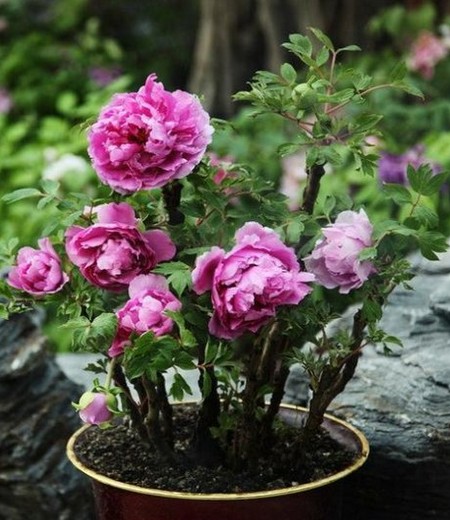
Variety selection:
Peony bonsai has relatively strict requirements for varieties. Varieties with a relatively high flowering rate, moderate growth, and relatively easy shaping should be selected. Such as "Zhusha Lei", "Zhao Fen", "Hu Hong", "Qinglong Wo Mochi", "Zhi Hong" and other varieties. In addition, although "Sheng Dan Lu" has fewer flowers and a large growth amount, it grows robustly, with sturdy and upright branches, and a relatively good natural plant form, so it is suitable as bonsai material.
Tree stump selection:
For the selection of peony tree stumps, from the perspective of rapid shaping, those stumps that are suitable for shaping or have rustic and dignified main trunks and are relatively old should be selected. Natural stumps with good landscape form are the most ideal.
Potting soil preparation:
Peony is a deep-rooted flowering plant with fleshy roots and relatively few fibrous roots. However, as a bonsai, the volume of the pot is limited, which causes the root nutritional area to be relatively reduced, creating an imbalance between underground and aboveground nutrition, thereby affecting the normal growth and development of the peony. Therefore, the scientific preparation of growing soil is crucial. According to the characteristics of peony, the growing soil should be loose, fertile, high in humus content, and long-lasting in fertilizer effect. According to our research, the relatively ideal formula is to mix humus soil, horse manure, garden soil, and furnace slag in a ratio of 2:1:2:1, mix them evenly, seal and compost them with human manure and urine, and use them after one month.
Potting time:
The timing of potting directly affects the quality of root development of the stump landscape and normal flowering the following year. Practice has proved that potting in mid-to-late September is relatively suitable.
Shaping methods:
Peony wood is hard and brittle, easily broken, and difficult to process.
1) Bend the main trunk, following its natural form as much as possible. When potting, plant it at an angle. First wrap the bending area with binding rope or palm fiber, then insert metal wire of corresponding thickness (No. 12-18) from the base, and wrap it at a 45° angle, in the same direction as the intended twisting direction, so that it becomes tighter as it is wrapped. Or use hemp rope for bow-shaped traction, operate in stages, gradually bend it, and gradually achieve the shaping purpose.
2) For branch (twig) treatment, pruning is mainly used. The hierarchy of the stump landscape, retention or removal of branches and buds, etc. should consider the relationship between density and sparsity, virtual and solid, and spatial layout, so as to achieve the ideal effect.
3) Root treatment: Exposed roots can balance with the center of gravity of the crown and echo the upper and lower parts, making the roots resemble tiger paws or eagle claws, rich in a sense of strength. The method of gradually washing away the potting soil can be used for root exposure, raising the roots year by year. Peony leaves are large and fat, and can be controlled by controlling water and fertilizer and spraying chlormequat.
Pot surface treatment (stone arrangement and moss covering):
Taihu stone and stalagmite stone are preferred for stone arrangement. They can be placed lying down or upright, paying attention to the harmony and balance of the entire work. Covering with moss can increase the beauty of the work and play a role in moisture retention and temperature insulation.