Detailed Explanation of Plum Blossom Bonsai Cultivation and Production Techniques
Plum blossom bonsai making is an art and a culture. It is only through the relentless study of countless predecessors that today's plum blossom culture has taken shape. Learning and summarizing this culture is a responsibility and obligation for our generation, especially for those of us who love plum blossoms. Let us carry on this cultural art and develop it further.
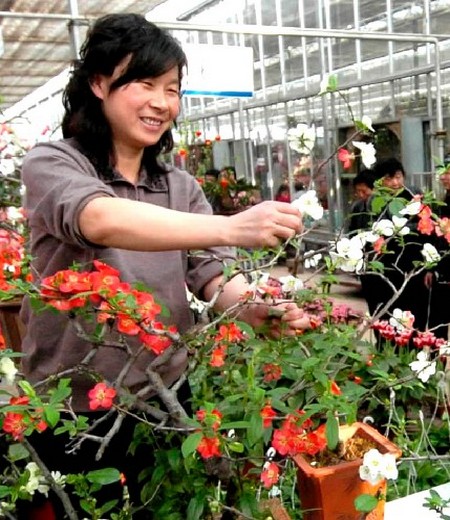
The bonsai cultivation and production methods are as follows:
Seedling sources:
Plum stumps are mostly cultivated by grafting and layering. You can also directly seek out wild plum stumps with graceful shapes, or choose graceful apricot stumps and the like as rootstock for grafting.
Potting:
This is generally done in early spring after the flowers fall. Choose loose soil with good drainage and good water and nutrient retention for potting. The pot soil should not be too full, otherwise aeration will be poor, which is not conducive to the growth and flowering of the plum blossom. The size and style of the pot should be determined according to the plum stump. The pot should not be too large, otherwise it is easy to cause excessive vegetative growth of the plum stump.
Pruning:
Pot-grown plums have strong sprouting ability and tend to produce too many branches. Therefore, after flowering each year, the current-year branches should be shortened to retain 2-4 buds. When pruning the annual branches of a pot-grown plum, the scissors should be placed from the opposite side of the bud so that the cut forms a 45-degree bevel, with the upper side of the cut level with the tip of the bud and the lower side of the cut level with the base of the bud.
Shaping:
According to the form of the plum stump, various styles can be created, such as straight-trunk style, slanting-trunk style, curved style, and cascade style. The methods mostly adopt coir rope wrapping and bending, with rough bending and rough pruning. After flowering, the branches should be heavily pruned once, retaining 2-3 buds at the base of the branches and cutting off the remaining branches. The retained branches should be sparse rather than dense. When the new shoots grow to about 10 cm, thin them out.
Fertilizing:
The principle of going from less to more, from light to concentrated, and proceeding step by step should be followed, so as not to damage the roots and cause death by fertilizing too early or too concentratedly. During the growing period, pot-grown plums should be given water-soluble fertilizer once a week, and at the same time foliar fertilizer should be applied 2-3 times a month to promote flower bud formation.
Key points for fertilizing: 1. Water-soluble fertilizer should be applied when the pot soil is dry. 2. Weed and loosen the soil beforehand. 3. Do not use raw fertilizer. 4. Do not fertilize on rainy days. 5. It is best to fertilize on cloudy days or in the evening.