How to make a Chinese mosquito fern bonsai? Master these key points
Chinese mosquito fern (Distylium chinense) has a low trunk with varied shapes and emerald-green leaves that stay evergreen all year round. It is an excellent and highly precious tree species for making bonsai. If placed indoors in a pot, it greatly shows the owner's elegance and refinement. It is drought-tolerant, waterlogging-tolerant, tolerant of pruning and shade, with few pests and diseases, small leaves, and evergreen throughout the year. It can be grown in all areas except Heilongjiang and Jilin provinces.
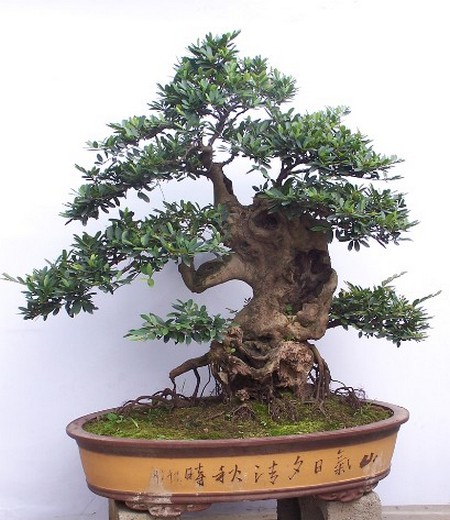
Mosquito fern can be propagated by cuttings in spring and summer, and can also be propagated by sowing in spring. When the seedlings grow to a suitable size, they can be shaped. You can also use old mosquito fern stumps that have grown for many years, are short in stature and ruggedly ancient to make bonsai. They are generally transplanted before sprouting in spring or during the rainy season. Before transplanting, give the stump a rough pruning first, cutting off excess branches. The root system should also be properly pruned, cutting off overly long main roots and keeping more lateral roots and fibrous roots. After digging up, do a good job of preserving freshness and moisture. First plant it in a clay pot or in the ground to “nurture the blank”, and after it survives, proceed with shaping, then move it into a fine pot for display.
Mosquito fern branches are supple and flexible, with strong sprouting ability and tolerance to pruning. It is suitable for making different forms of bonsai such as straight-trunk style, curved-trunk style, slanting-trunk style, dead-wood style, double-trunk style, cascade style, and waterside style. The crowns of Chinese mosquito fern (Distylium chinense) and Chinese fine-leaf mosquito fern, which have smaller leaves, are often processed into neat cloud-pad shapes, while the crowns of mosquito fern and bayberry-leaf mosquito fern, which have larger leaves, are mostly made into free and elegant natural shapes. The processing method uses both wiring and pruning.
For young trees, shaping should be carried out step by step according to the design, and attention should be paid to cultivating and raising the roots so that they are exposed and claw-like, to show their ancient and varied character. For old stumps that have grown for many years, guide them according to their tendency and shape them according to the stump, making the most of the stump's original form, supplemented by pulling, wiring and pruning, to highlight its natural beauty.
Key production points:
1) Collecting: same as conventional.
2) Trimming the stump: trim the stump in one go, smoothing the branch ends, root ends and wounds, and seal them. Soak in disinfectant and rooting agent for 5-8 hours.
3) Nurturing the blank: use loose, plain soil, sterilized. Sand cultivation is better for bare stumps. Plant shallowly, water thoroughly until the roots are reached. Create a microclimate according to its habits. Provide shade in the early stage.
4) Potting: one week before the Start of Autumn, use slightly acidic loose soil, and place according to its habits.
5) Shaping: apply techniques according to the material. Combine trunk chopping and branch growing, pruning, and wiring. Combine both restraint and release.