Detailed Explanation of the Key Techniques for Making Fruiting Ginkgo Bonsai
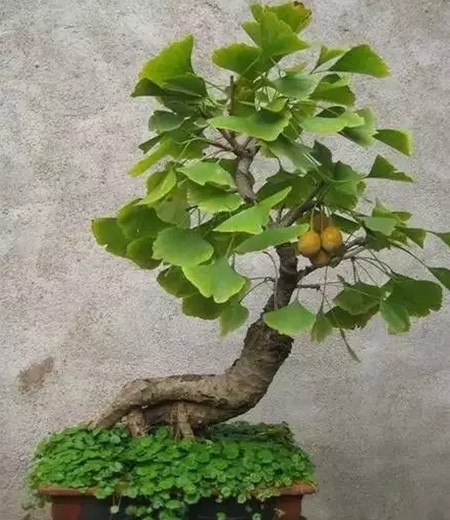
Fruiting ginkgo bonsai can be divided into: A Single Branch Standing Out (single branch), Flying Wing to Wing (two branches), and Three Legs of a Tripod (three branches). As the saying goes: “If you have a son but no grandson, do not plant a ginkgo orchard,” meaning that only when the grandfather plants the ginkgo tree can the grandson benefit, which shows how slowly the ginkgo tree grows and how late it bears fruit. Generally, for a ginkgo bonsai to take shape and bear fruit, it takes even longer and later. However, after years of experimentation, the author can make a ginkgo bonsai take shape in 2—3 years and bear fruit in 3—4 years.
Potting soil:
Use fertile fine soil and organic fertilizer (such as rapeseed cake and animal manure), mix in 0.5% high-quality N, P, K compound fertilizer, and pile it to compost and decompose.
Production:
Leave 4~5 small holes in the lower part of the middle container for air and water drainage. The rootstock for ginkgo bonsai can be raised either from seeds or from 1~3-year-old seedlings. Pinch the growing tips of the ginkgo seedlings and cultivate them separately into rootstocks with: a single branch, 2 branches, and 3 branches, so as to correspondingly cultivate “A Single Branch Standing Out,” “Flying Wing to Wing,” and “Three Legs of a Tripod.” Place the middle containers that have already been sown or planted with seedlings on flat ground at a spacing of 0.5 m×0.4 m, and cover the surroundings with fine soil to preserve water and fertilizer.
Planting of seedlings is carried out in October. Sowing is carried out in spring. Grafting is carried out in autumn, at a temperature of 12~16°C (mid-to-late March).
Grafting:
Collect 1~3-year-old flower-bud branches from the middle part of a fruiting mother tree, and graft using the cut grafting or cleft grafting method: the scion for “A Single Branch Standing Out” can use 3~4 flower buds, preferably with a terminal bud; for “Flying Wing to Wing” and “Three Legs of a Tripod,” each branch scion should have 2~3 flower buds.
Choosing this period for grafting, the graft union can both heal and not sprout, and it will bloom when the weather warms up the following spring. After the female flowers mature, manual pollination is carried out. 45 days after pollination, the ovules are seen to swell obviously, and the seeds enter a period of vigorous growth; keep 2~3 seeds per branch and strengthen water and fertilizer management, so that from the flower buds both seeds grow and new branches can also sprout.
In June, the middle container can be removed, and the plant can be transplanted into a pot and put on the flower market, which will certainly bring considerable economic benefits.
Fertilizer and water:
To cultivate ginkgo bonsai quickly, well, and economically, the only way is to first let the seedlings grow in the ground for 3 years (including 1 year as rootstock seedlings). Growing in the ground is 1-2 times faster than growing in pots, which helps promote rapid thickening of the trunk and rapid formation of the crown. Suitable fertilizer and water are important measures for managing ginkgo well. The seedling field should be given 5 cubic meters of high-quality barnyard manure, 50 jin of diammonium phosphate, and 100 jin of ammonium bicarbonate per mu as base fertilizer. Each spring, apply nitrogen fertilizer as a top dressing, and in summer apply phosphorus and potassium fertilizer. After top dressing, if the soil is dry, combine it with watering. During the growing period, spray foliar fertilizer once every 20 days. Usually, water during drought and drain during waterlogging, letting it “eat well and drink well” to promote fast growth and early fruiting.