How to make a purple bamboo bonsai? A complete step-by-step guide
Purple bamboo, also known as black bamboo, dark bamboo, or running bamboo, is a culm-ornamental bamboo type. Its culms are purple-black, soft and glossy, hidden beneath green leaves, and very exquisite. Its name is unforgettable at a single glance. It can not only be planted together with bamboo species that have colorful culms, such as yellow-groove bamboo, golden bamboo, and mottled bamboo, in a bamboo garden to add color variation. It can also be potted and placed in front of a window or on a table, offering a distinctive charm. It not only has ornamental value, but is also a medicinal plant, and can also be used to make small furniture or items such as fishing rods, walking sticks, and musical instruments.
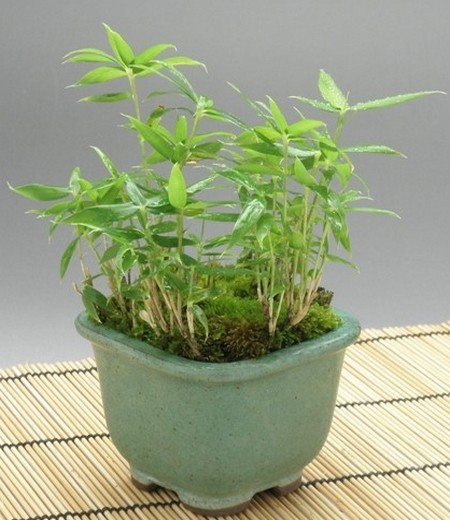
Bamboo is one of the favorite plants used in Chinese-style gardens. Bamboo branches and culms are upright and slender, evergreen through all four seasons, and proud through frost and rain, making them much loved by everyone. They even have elegant titles such as one of the "Four Gentlemen" of plum, orchid, bamboo, and chrysanthemum, and one of the "Three Friends of Winter" of plum, pine, and bamboo. Planting a few purple bamboos or a few pots of purple bamboo at home or in the garden adds a bit more cultural charm.
Choosing purple bamboo
Although many kinds of bamboo can be used to make a bamboo bonsai, people often choose purple bamboo when selecting materials. This is because an ancient folk legend says that "Guanyin was born in a purple bamboo grove," so some people believe that purple bamboo can ward off evil. In a large courtyard, if there is purple bamboo, then all evils cannot intrude and malevolent spirits stay far away. In fact, purple bamboo plants are small and delicate. Among garden bamboos, this bamboo is suitable for planting among courtyard rocks or beside a study, hall, small path, or pond, and can also be planted in pots and placed in front of a window or on a table, offering a distinctive charm. Purple bamboo has purple-black culms and emerald green leaves, and is quite distinctive.
Dwarfing treatment
1. Propagation dwarfing (dwarfing bamboo rhizomes in pots). In bamboo production practice, bamboo grown from dwarfed bamboo rhizomes is noticeably shorter than bamboo grown naturally. Bury the bamboo rhizome in a pot, cover it with 5 to 10 cm of soil, and maintain humidity. Bamboo grown in a natural climate reaches only one-fifteenth to one-ninth of its natural height. However, although bamboo grown this way is elegant and gentle, its culms are thin and the plant looks weak, giving the impression of a slender maiden, and it is mostly favored by elegant literati and ladies.
2. Shoot-peeling dwarfing (field cultivation). There is a phenomenon in bamboo growth: once the outer sheath is peeled off, the internodes of that section of bamboo become shorter. If, when the bamboo shoot has grown to 20 cm, you gradually peel off one or two sheaths from the base, then each internode becomes shorter, and the whole bamboo plant becomes shorter.
In practice, it has been observed that because bamboo is a shade-loving and water-loving plant, it grows quickly after rain; after rain with high temperatures, it grows even faster. Therefore, if you want the internodes to grow evenly, you must properly control how many sheaths are peeled and when. Generally, under normal and stable temperatures, peel off one sheath every afternoon. If it is hot and humid, peel off one in the morning and one in the evening. Note that you should not peel too many at once, causing the bamboo shoot to lose water or become infected with bacteria and die. If the interval between peelings is too long, the dwarfing effect is not ideal; if the interval between peelings is too short, the internodes become too short or break. How to accurately control the timing and amount of sheath peeling mainly depends on flexible judgment based on local climate changes and growth rate
3. Dwarfing agent treatment. In garden practice, scientists have researched and experimented with methods of treating bamboo with dwarfing agents. One method is to spray directly during the bamboo's rapid growth period, which can reduce height by one-third to two-fifths. Another method is to use a syringe and needle to inject a dwarfing agent into the bamboo shoots.
The injection dose and concentration are also determined by the bamboo's growth rate. Because temperature and humidity differ each day, and bamboo reaches its full height in only two weeks during the culm-forming stage, the daily growth rate varies. How to accurately control it must be determined according to the local characteristics of bamboo growth. In addition, the proportions and types of dwarfing agents also differ. If controlled properly, it depends on your own long-term observation and accumulated experience for flexible use. When used appropriately, internodes can reach 3 cm, with the whole plant having even internodes and consistent thickness; or you can control the dose according to the thickness you want.
Shaping and management
1. Transplanting after dwarfing. Purple bamboo that has been dwarfed in a bamboo forest or field needs to be transplanted. When transplanting, choose clear weather and try to avoid bacterial contamination. When digging it up, keep plenty of original soil; it is best to take it out with a root ball.
2. Temporary planting. After taking out the field-dwarfed purple bamboo, do not plant it directly in a pot. It needs to be temporarily planted in an outdoor environment close to that of a large pot to recover from root damage caused during digging and to improve its ability to adapt to the new environment.
3. Shaping and cultivation. Dwarfed purple bamboo still needs the photosynthesis of bamboo leaves to provide nutrients. Too many branches and leaves consume more water, and at the same time the shape also needs some branches and leaves for embellishment. Therefore, retain suitable branches and leaves according to your shaping needs.
4. Transplanting. Choose a clay pot of appropriate size with good water absorption and drainage: it is best to transplant in early spring, when the temperature begins to rise, transpiration is low, and fibrous roots revive easily.
5. Management. Maintain moderate sunlight and avoid exposure to strong sun; do not let it lack water or lose water. Choose fully decomposed cake fertilizer, compost, or poultry manure, or apply 1% ammonium sulfate or 5% urea. You can also spray 0.5% potassium dihydrogen phosphate on the leaves once a week for three consecutive weeks.