How to make a bamboo bonsai? A step-by-step guide to the method
The bamboo is elegant and graceful, refined and classic; used to make small bamboo bonsai, it adds a touch of charm when decorating a room. There are many varieties of bamboo, and for making bamboo bonsai, small bamboos with thin, short culms and narrow leaves are best, such as Pleioblastus fortunei (dwarf white-stripe bamboo), Bambusa ventricosa (Buddha belly bamboo), small-leaf Phoenix-tail bamboo, and Hibanobambusa tranquillans 'Shiroshima'.
For transplanting bamboo, it is best in spring to select one- or two-year-old well-developed root bamboo with rhizomes, and dig it up with the roots; when transplanting, the roots should retain some native soil, the main culm should be cut short, and about 50 cm of culm should be left for potting. It is best to first plant it in a small clay pot, and after it survives, plant it permanently in a shallow pot. The soil for bamboo bonsai is best as humus soil. Because the growth of potted bamboo is controlled, the small bamboos put out in spring and autumn are relatively slender and short, so they are very suitable as material for bamboo bonsai. After planting, water once thoroughly, place it in a cool, moist, ventilated place and grow it for one year; the following year it can be processed into a small bamboo bonsai.
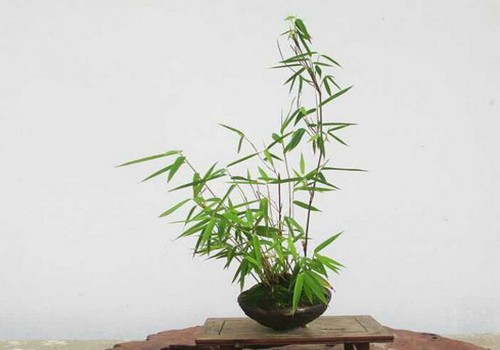
According to the different types of bamboo, different ways of arranging the scene can be adopted. Small bamboos such as Pleioblastus fortunei can be planted in a square or oval pot; medium-sized bamboos such as green bamboo can be planted in a rectangular or oval shallow pot. If planting on one side of the pot feels unbalanced, a beautiful stone of appropriate proportion to the size of the bamboo can be placed at the other end of the pot, which can both achieve balance and add interest to the bonsai, making it look lively and natural. Large bamboos such as Phyllostachys sulphurea (golden bamboo), Phyllostachys glauca (glaucescent bamboo), and Phyllostachys bambusoides f. lacrima-deae (spotted bamboo), if used to make bonsai, must undergo artificial dwarfing treatment and be planted in medium or small shallow pots,
only then can the effect of "shrinking a dragon into an inch" be achieved. Bamboo bonsai should be planted sparsely, not densely; scattered planting is better than close planting. With just three, five, or seven branches, arranged in order of height and with a sense of spacing, laid out naturally, planted in a shallow pot, accompanied by beautiful stones at the side, with a little moss arranged around them, plus one or two ancient-style pottery figures, strolling among them, it is full of poetic and painterly charm and can be called an excellent bonsai; it can make the whole bamboo bonsai present a natural bamboo forest scene. Otherwise, it will be chaotic and disorderly, like a pile of reeds or weeds, with none of the charm of a bonsai, and it will lose its ornamental value.
The techniques for making bamboo bonsai are introduced as follows:
[Selection of varieties]
Bamboo bonsai is mainly made from ornamental bamboos, such as: Bambusa ventricosa (Buddha belly bamboo), Bambusa multiplex cv. 'Fernleaf', Bambusa multiplex (hedge bamboo), Pleioblastus fortunei (dwarf white-stripe bamboo), Phyllostachys nigra (black bamboo), Chimonobambusa quadrangularis (square bamboo), Phoenix-tail bamboo, Phyllostachys bambusoides 'Castillonis' (golden bamboo with green stripes), Phyllostachys bambusoides 'Castillon Inversa' (green bamboo with golden stripes), variegated moso bamboo, and Zhejiang East four-season bamboo, etc.
[Cultivation of bamboo stumps]
Bamboo grows tall, generally all above one meter, so to make it into a bonsai, it must be dwarfed by some means.
Burying rhizomes to grow bamboo stumps:
This is a cultivation method that uses the strong buds on the rhizome to sprout into bamboo stumps. Its advantages are a short cultivation time, low dwarfing cost, and the ability to maintain the plant's own excellent characteristics. The specific method:
(1) Selection of bamboo stump land:
It is best to choose a place with a southeast or southwest slope, a slope of 8 to 10 degrees, moist and fertile acidic or neutral loam, or sandy loam, with convenient drainage and irrigation, as the bamboo stump growing land.
(2) Selection of rhizome sections:
Choose 2- to 3-year-old brass-colored strong rhizomes with dense, plump, robust buds and no pests or diseases; rhizome length can be 30 to 40 cm or 50 to 60 cm.
(3) Preparation of the bamboo stump land:
For any nursery land prepared for cultivating bamboo stumps, the soil should be plowed 30 cm deep in the winter of the previous year, harrowed fine, and given sufficient base fertilizer. In addition to applying 500 to 700 kg of barnyard manure per mu, 50 to 60 kg of superphosphate or calcium magnesium phosphate fertilizer should also be applied, to meet the fertilizer needs of bamboo stump seedlings for rooting and leaf growth.
(4) Season for cultivating bamboo stumps:
From mid-February to the end of March, when the rhizome buds begin to sprout (in the Zhejiang East region); in the north, mid-to-late April is suitable.
(5) Method:
Prepare the land into beds one meter wide and 25 cm high, with a row spacing of 20 cm, and dig trenches 20 to 25 cm wide. Per mu, 1,500 to 2,000 rhizome sections can be buried, producing 2,000 to 2,500 bamboo stump seedlings.
(6) Management:
To keep the nursery land moist at all times, the bed surface can be covered with rice straw (or thatch). After burying the rhizome sections, if rain and temperature are suitable, sprouting begins after 35 to 40 days. At this time, the covering straw should promptly be spread between the rows and weeds completely removed, to prevent pest and disease damage and trampling by cattle and sheep. Vegetables and other crops can be interplanted in the spaces between bamboo stumps to speed up the growth of the bamboo stumps. [Potting techniques]
(1) Preparation of pot soil: bamboo is suitable for growing in deep, fertile, loose soil, so the pot soil is best as acidic or neutral yellow loam or sandy loam; mixing in sieved leaf mold is also very suitable.
(2) Potting time: bamboo bonsai can be potted throughout the year except in the high-temperature season from July to September, when evaporation is high and survival is difficult. The most suitable season is mid-to-late March in the Zhejiang East region and mid-to-late April in the north. In short, once the soil thaws in spring and the temperature begins to rise, it can be done.
(3) Points to note:
A. To enable the bamboo stump to quickly send out rhizomes and shoots after potting, apply a dilute fertilizer solution once 7 to 10 days after potting (50 kg of water mixed with 5 to 10 kg of human urine and manure).
B. When potting, the length of the rhizome roots should be determined according to the size of the container (the bottom of the pot must have holes for ventilation and drainage). But one point must be noted: be very careful not to twist or injure the connection between the bamboo culm and the rhizome, so as not to block the transport of water and nutrients and affect survival; also, the fibrous roots must be straightened and the soil pressed firm.
C. To save planting material, according to the needs of making the bonsai, one rhizome with one culm, two culms, or multiple culms can be potted.
[Management] After the bamboo stump is potted, be careful not to let direct sunlight hit it, and remove weeds in time. After about one month of growth, appropriately water with dilute human urine and manure; by the end of the year or the following spring it can leave the nursery.
To increase the beauty of the bamboo bonsai, when planting the bamboo in the pot, the roots can be raised for planting. After the bamboo has grown and developed for a period, remove part of the surface soil around the roots, so that part of the bamboo roots is exposed above the surface soil, showing the look of hanging roots and exposed claws, revealing the beauty of the bamboo roots, which is very pleasing to view.
Placement location:
Bamboo bonsai should be placed in a warm, moist, wind-sheltered, sunny place. In summer it should not be exposed to strong sun; it is best placed under a shade shed or beside a water pool. Bamboo species that are not cold-tolerant in winter (such as Bambusa ventricosa and small-leaf Phoenix-tail bamboo) should have their pots moved indoors to keep warm and prevent cold damage.
Watering:
In the management of bamboo bonsai, special attention must be paid to the water supply. During the vigorous growth period or in high summer temperatures, water and spray frequently. Although bamboo likes moisture, it dislikes water accumulating in the pot, otherwise it very easily causes rhizome (root) rot.
Fertilizing:
Although bamboo likes fertilizer, in pots it should be applied as little as possible, and only light fertilizer. From May to August each year, 2-3 additional applications of dilute, fully rotted cake fertilizer water, etc. can be given. If the pot soil lacks nutrients, it will cause poor growth (such as dull, not bright leaf color, etc.).
Pruning:
Bamboo sprouts and grows relatively quickly; usually pay attention to pruning so as to keep the bamboo bonsai graceful in form. Overlapping branches, crossing branches, and branches that affect the beauty of the shape can be pruned at any time, and excessively long branches can be cut short. After the bonsai has taken shape, generally the newly emerging shoots can be pulled out promptly, so as to avoid disrupting the bamboo bonsai's shape and consuming nutrients that affect the vigor of the mother bamboo...
Repotting:
Repot bamboo every 2 to 3 years, preferably in April-May. When repotting, be careful to protect the fibrous roots on the rhizome roots, and fill in fertile, loose cultivation soil. After repotting, place it in a shaded place and keep the pot soil moist; spray water on the leaves frequently to prevent the leaves from shrinking.
Pest and disease control:
Potted bamboo has relatively few pests and diseases, mainly bamboo borers, scale insects, aphids, etc., which can be sprayed with 800 times dilution of trichlorfon or 1000-1200 times dilution of dichlorvos.
Usually, as long as it is cared for with a little care, keeping it always in beautiful condition with green, elegant, and attractive branches and leaves, one pot of bamboo bonsai can be enjoyed for a long time.