How to make a Buddha belly plant bonsai? Mastering these key points is essential
The Buddha belly plant (Jatropha podagrica) is a succulent in the Euphorbiaceae family. Its stem is short and thick, fleshy, with a swollen base that resembles the belly of Maitreya Buddha, which is how it got its name. The leaves are palmately peltate with 3 to 5 lobes, and the leaf scars are large. The flowers cluster at the tips of the branches, are orange-red, with five petals, and the branched flower stalks resemble red coral, which is why it is also called the coral flower. Because of its unusual form, bright flower colors, and continuous blooming throughout the year, it is favored by people.
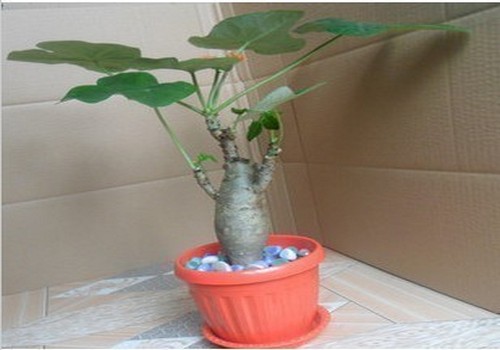
The Buddha belly plant prefers warmth, dryness, and ample sunlight. It is robust by nature, has an unusual plant shape, and is easy to cultivate, making it an excellent flowering plant for indoor potting. In warm regions it can also be grown in courtyards, and can also be used as a landscape tree or made into handicrafts.
The Buddha belly plant has an unusual plant shape. It attracts attention with its thick, bottle-shaped trunk that stores a large amount of water. A single plant forms a landscape, with a bizarre form and continuous blooming throughout the year. It is a fine indoor potted plant that has long been cultivated in China.
To make a Buddha belly plant bonsai, pay attention to the following two aspects:
1. Creating a landscape with a single tree. The most important characteristic of the Buddha belly plant is that it has very few branches. When making a bonsai, the pot surface should be slightly open and spacious; the solution is to add companion scenery, such as decorating with small landscape stones or a small rockery. A lying stone paired with a tall tree can make the tree appear even taller, "towering into the clouds." A "tall pagoda" and a "pavilion" indicate that there are "temples" and "villages" nearby, making the landscape colorful and varied. The Buddha belly plant has a slender branch form. To reduce its height, the stem can be shortened by more than 1/3, which can encourage side branches to grow. After shortening, it can sprout left and right side branches and send out flower stalks, blooming with many small flowers, gorgeous and charming like red coral.
2. Making a combined bonsai means planting 2 Buddha belly plants of different sizes together in the same shallow pot. It is best to choose an oval shallow pot, as this can visually reduce the height of the bonsai and also conforms to the principle of "tall trees paired with low pots," enhancing the artistic value of the display.