Detailed guide to making a five-color lantana bonsai, beginners can easily learn it too
The five-color lantana used for making bonsai can be propagated by cuttings, generally carried out in the growing season. Cut robust one-year-old branches, one section every two nodes, insert them in sandy soil or vermiculite, and keep them under a shade shed, maintaining soil and air moisture. They root in about 40 to 50 days, and can then be divided and potted up. Seedlings should be planted in fertile soil rich in humus. After planting, strengthen water and fertilizer management so the plant grows quickly and the trunk thickens, and promptly prune excess branches and control the plant's height. Once the plant reaches a suitable size, shaping can begin. In addition, old branches with graceful forms can also be used directly for cuttings, and after rooting they will soon bloom. You can also choose old five-color lantana stumps that have grown for many years to make bonsai; their branches are vigorous and antique-looking, with high artistic and ornamental value, but such stumps are very hard to find, especially in the north where they are even harder to find.
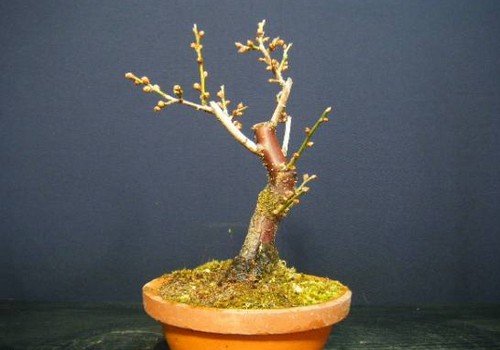
The branches of five-color lantana are soft and drooping, making it especially suitable for making cascade-style bonsai. In addition, it can also be processed into different forms of bonsai such as single-trunk style, double-trunk style, slanting-trunk style, waterside style, and deadwood style. The leaves of five-color lantana are relatively large, and the canopy often adopts a free and natural shape, so there is no need to deliberately tie it into a round disc shape. Because it grows quickly, has strong sprouting ability, and tolerates pruning, the shaping method should focus mainly on pruning, supplemented by wiring and pulling; the branches of five-color lantana are straight and lack grace, so metal wire can be used to bend them. The Lingnan school's "trunk chopping and branch accumulating" technique can also be used for shaping.
Five-color lantana is native to tropical America, and there is also a small amount growing wild in southern China. It likes a warm, humid environment with plenty of sunlight and is not cold-tolerant. From spring to autumn, the growing season, a finished bonsai can be kept outdoors in a sunny spot. Even in midsummer, shading is not necessary, but good ventilation is required. If light is insufficient, the plant will grow leggy, with thin and long stems and branches, and few flowers, seriously affecting its ornamental value. During the growing season, keep the potting soil moist, avoid excessive dryness, and pay attention to spraying water on the leaves to increase air humidity; apply a light fertilizer mainly of phosphorus and potassium about once every 15 days to provide sufficient nutrients so the plant blooms more. Five-color lantana grows relatively quickly, so during cultivation, promptly prune branches and leaves that affect the shape to maintain the beauty of the tree form. After each flowering, cut back overly long young branches. In late autumn and early winter, before moving the plant indoors, carry out a heavy pruning, appropriately shortening all current-year branches. In winter, move it indoors to a sunny spot. If a room temperature above 15°C can be maintained, the plant can grow and bloom normally, and should be watered, fertilized, and pruned appropriately. If such a high temperature cannot be maintained, reduce watering, stop fertilizing, and let the plant go dormant; it can safely overwinter above 8°C. Repot once every spring, and prune and reshape the plant again, cutting off dead branches, weak branches, and other branches that affect the tree shape.
Potted five-color lantana should be repotted before being moved outdoors in spring. It is best to apply sufficient base fertilizer and appropriately prune the branches. If it is a small seedling, pinch the top to encourage side branches. For a shaped plant, pay attention to thinning out weak and diseased branches and appropriately cutting back to maintain a good tree shape and encourage more new shoots. If seeds are not wanted after flowering, remove the spent flowers to help new flower clusters emerge from the leaf axils below. During the growing season, keep plenty of sunlight and moist soil, not too dry, especially during flowering. If it is too dry, wilting is likely to occur and flowering will be affected.
From May to October, apply cake fertilizer water once every 7 to 10 days. Especially after flowering, topdress in time to keep flowers blooming continuously. At the end of October, move it indoors. In East China, it can be placed in a cold room to overwinter. If the indoor light is sufficient and the temperature is above 10°C, it can still bloom. After moving indoors, control watering and stop fertilizing. Overly long new shoots can be appropriately shortened for easier storage.
From spring to autumn, the growing season, a finished five-color lantana bonsai can be kept outdoors in a sunny spot. Even in midsummer, shading is not necessary, but good ventilation is required. If light is insufficient, the plant will grow leggy, with thin and long stems and branches, and few flowers, seriously affecting its ornamental value. During the growing season, keep the potting soil moist, avoid excessive dryness, and pay attention to spraying water on the leaves to increase air humidity; apply a light fertilizer mainly of phosphorus and potassium about once every 15 days to provide sufficient nutrients so the plant blooms more.
Five-color lantana grows relatively quickly, so during cultivation, promptly prune branches and leaves that affect the shape to maintain the beauty of the tree form. After each flowering, cut back overly long young branches. In late autumn and early winter, before moving the plant indoors, carry out a heavy pruning, appropriately shortening all current-year branches.
In winter, move it indoors to a sunny spot. If a room temperature above 15°C can be maintained, the plant can grow and bloom normally, and should be watered, fertilized, and pruned appropriately. If such a high temperature cannot be maintained, reduce watering, stop fertilizing, and let the plant go dormant; it can safely overwinter above 8°C. Repot once every spring, and prune and reshape the plant again, cutting off dead branches, weak branches, and other branches that affect the tree shape.