A Detailed Guide to Making a Golden-edged Daphne Bonsai
The daphne's branches spread gracefully, with soft twigs and thick leaves, elegant and beautiful in posture. Golden-edged daphne belongs to the Thymelaeaceae family, genus Daphne, and is an evergreen small shrub, a variety of daphne. At any time, planting plants is a technical skill that tests a person, requiring not only knowledge but also plenty of patience and care. So next, let's take a look with the editor at how to make a golden-edged daphne bonsai!
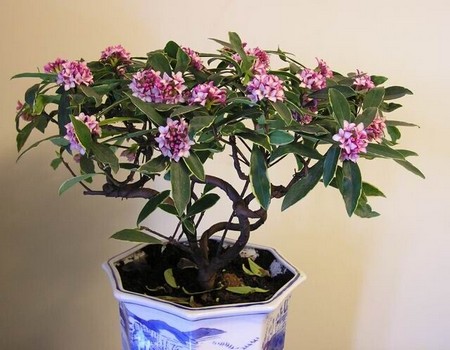
Golden-edged daphne has a strong fragrance and prefers semi-shade or sunny spots, avoiding scorching sun and heavy rain. Golden-edged daphne has poor cold tolerance and does not tolerate waterlogging. It is suitable for growing in fertile, loose, well-drained, slightly acidic soil. In everyday management, a relatively extensive management approach is adopted.
1. Potting soil
The pot used for a golden-edged daphne bonsai should be of moderate size, and it should be planted shallowly in soil containing humus, loose and slightly acidic. The potting soil ratio is garden soil : leaf mold : sand = 4 : 4 : 2. After the potting soil for the bonsai is mixed, sterilize it under the scorching sun.
2. Propagation
In spring, take 8 cm to 10 cm from the top of last year's branches, keep 2 to 3 leaves at the top, dip in rooting powder, and insert into the cutting medium. The insertion depth is 1/2 to 2/3 of the cutting. Water thoroughly and keep the cutting medium moist but on the dry side. Roots can form in about 20 days.
In summer, take tender branches of the current year as cuttings. The insertion depth is about 1/2 of the cutting. After inserting, water thoroughly, then keep the cutting medium moist but on the dry side, but the leaf surface needs frequent spraying until roots form. In addition, grafting in spring, summer and autumn and air layering can also be used for propagation.
3. Potting up
Pot selection: For daphne, a slightly deep round or square pot is preferable; an oval or rectangular pot also works. The pot material is best purple clay pottery. The pot color can be chosen as sunflower yellow or light gray, to set off the green leaves and variegated flowers, creating an enhancing and contrasting effect.
Soil: Daphne likes to grow in fertile, loose, satisfactorily drained sandy fertile soil, requiring slightly acidic soil with a pH value between 6 and 6.5. For bonsai, it is suitable to use leaf mold or sun-dried, weathered field soil mixed with an appropriate amount of rice husk ash or sandy soil.
Planting: It is best to pot up and plant in April in spring. At this time the climate is mild and humid, with a small temperature difference between day and night, which helps the daphne establish in the pot and grow. Autumn planting is also possible. When transplanting, more original soil must be kept with the roots, and appropriate pruning of the branches should be carried out.
4. Watering
The leaves of golden-edged daphne contain a large amount of wax, so the transpiration of the leaves is very small, and therefore it does not tolerate moisture. In normal times, watering should follow the principle of watering when dry and stopping when wet. In early spring when the buds are about to sprout, water once thoroughly; afterward, water thoroughly again only after the potting soil has dried out.
In summer, besides maintaining alternating dry and wet conditions in the potting soil, it is also necessary to spray water regularly around it and on the leaf surface to lower the temperature. In late autumn, keep the potting soil in a semi-dry state to slow down the growth vigor, which is beneficial for overwintering. In winter, when growth stagnates, the potting soil should be on the dry side, and watering should be reduced.
5. Fertilizing
Golden-edged daphne does not like heavy fertilizer. Under normal circumstances, applying a diluted, well-rotted liquid fertilizer once a month is sufficient. Applying a diluted liquid fertilizer once before and after flowering can make the plant lush, with fragrant flowers and vivid colors.
Fertilizing precautions: (1) Do not splash or get the fertilizer liquid onto the leaves. (2) Fertilizing should be done when the potting soil is dry. (3) Do not apply human manure or chemical fertilizers.
6. Pruning
Pruning: Golden-edged daphne has strong sprouting ability and tolerates pruning. After flowering, it can be pruned and shaped according to the desired plant form, mainly removing weak branches, overly dense branches, and so on.
7. Shaping
Processing: For potted daphne, it is suitable to use wire to bend and tie the branches, combined with pruning, to carry out shaping. However, care must be taken to remove the wire early to avoid the wire cutting into the bark, which would affect appearance and growth. Processing and shaping are best done during the dormant period, and can also be done after flowering.
Tree form: The tree form of potted daphne is best made into a natural large-tree shape. The branches should be upright, elegant and spreading, and attention should be paid to appropriate spacing between dense and sparse areas, so as to favor elegant branches and abundant flowers, rich color and fragrance, and enhance the ornamental effect.
8. Repotting
Golden-edged daphne is generally repotted with new potting soil once every 2 years, carried out in early spring when the buds have not yet sprouted. After removing it from the pot, remove the outer layer of soil from the roots, keep the central soil, and add new culture soil for planting. The planting depth should be consistent with the original depth. If the golden-edged daphne plant is relatively large, it should be moved to a larger pot. After planting, firm the potting soil, water thoroughly, and place it in a cool, ventilated place for 10 to 15 days of care before carrying out normal cultivation and management.