How to make a Lonicera maackii bonsai? A full breakdown of the detailed method
Lonicera maackii, also known as Amur honeysuckle, is one of the most common tree species in landscaping. Its flowers are an excellent nectar source, its fruits are a treat for birds, and the whole plant can be used medicinally. The stem bark can be made into artificial cotton, and the seed oil can be used to make soap; it is also used as a landscaping tree species. Lonicera maackii has lush branches, dark green leaves and bright red fruits, giving it quite a good ornamental effect. Lonicera maackii is beautiful in both flower and fruit and has high ornamental value.
In spring you can enjoy the flowers and their fragrance, and in autumn you can admire the abundance of red fruits. In late spring and early summer it blooms in layer after layer, gold and silver setting each other off, so that from a distance the whole plant looks like a beautiful large flower ball. The flowers are elegant and fragrant, attracting bees and butterflies, which is why Lonicera maackii is also an excellent nectar-source tree species. In golden autumn, pairs of red fruits hang all over the branches, most endearing to the eye, and they also provide food for birds. In gardens, Lonicera maackii is often planted in clumps on lawns, hillsides, forest edges or roadsides, or dotted around buildings, suitable both for viewing flowers and enjoying fruits. So how do you make a bonsai from Lonicera maackii?
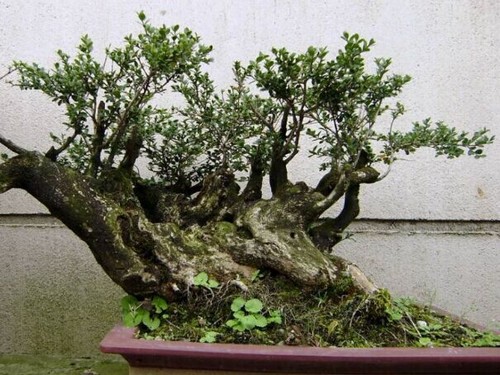
A Lonicera maackii bonsai uses the technique of compressing a thousand miles into a foot and seeing the great in the small to gather trees, rocks and more into a pot, and through artistic processing and year after year of careful cultivation, makes them into a miniature of natural scenery.
Planting:
To grow Lonicera maackii as a potted plant, it needs to be transplanted into a pot, and the best time is March in spring; the plant should be a 1-2 year old seedling. When digging up the seedling, it should be kept with native soil, and the fine roots should not be damaged. The potting soil should be fertile, loose, well-drained humus soil or garden soil.
The pot should be repotted once every 2 years, replacing half of the old soil and pruning away some of the surplus old roots, which helps flowering and fruiting.
Watering:
After planting, water once thoroughly. In routine care, keep the potting soil moist; especially before flowering and fruiting, it must not lack water.
Light:
After planting and watering, place the pot in a shaded spot; for 1 week do not expose it to sun and do not water it, and the survival rate will be higher.
Fertilizing:
In early summer before flowering, apply 1 time of dilute, fully rotted cake fertilizer water; after flowering, apply 1 time of phosphate fertilizer to promote fruiting. In winter, it is suitable to apply rotted poultry manure and bone meal as a base fertilizer.
Pruning:
Because Lonicera maackii has strong sprouting ability and suckering ability, it grows many new branches from the base every year, and after two years of cultivation it can take shape. After flowering, appropriately cut away some overly dense branches to improve ventilation and light penetration, which helps fruiting. After 3~5 years of growth, vigorous water sprouts or suckering branches can be used for heavy pruning to encourage new branches to grow and replace aging branches, while aging branches, thin and weak branches, and diseased and pest-damaged branches are thinned out.
Shaping:
According to different landscaping environments, it can also be trained into a small tree form. If training it into a tree-like form, after transplanting the seedling, select one strong branch and cut it back to set the trunk, and thin out the remaining branches; afterward, the side branches and suckers sprouting from the lower part should be pinched in time to control their growth and promote trunk growth.