Detailed Explanation of the Production Method and Steps for Chaenomeles speciosa Bonsai
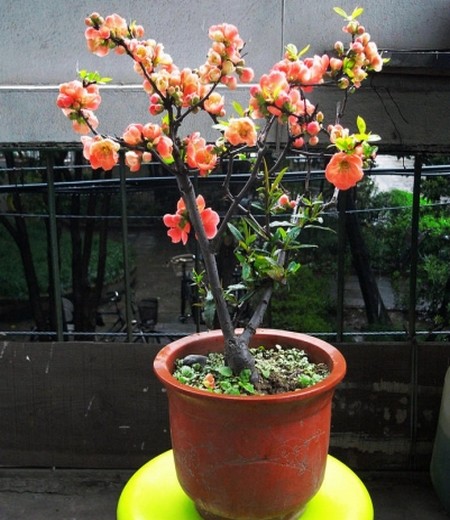
As a unique ornamental tree, Chaenomeles speciosa (flowering quince) dots the gardens and green spaces, a spot of red amid a myriad of greenery - that is probably the kind of beautiful scene it creates. It is colorful and varied, never tiring to look at, and the viewing process is a joy in itself. Its bonsai is usually placed in halls and leisure venues, and it can also be reasonably matched with buildings, adding splendor to the courtyard scenery and making it more elegant and refined.
[Material Selection and Cultivation Measures]
Artificial propagation: Mainly by division, cuttings and layering. Division should be carried out in early spring. Dig up the clustered mother plant with its roots, divide it with a sharp knife, and replant so that each division has 2~3 branches. After 3~5 years of growth, division can be carried out again. Cuttings fall into two types: hardwood cuttings and softwood cuttings. Hardwood cuttings are taken from February to March, with cuttings 10~15 cm long and inserted to a depth of about 1B2; softwood cuttings are taken during the plum rain season in June to July, inserted using the mud-slurry method, and root relatively easily. Layering can be done in winter or spring. Dig a small trench beside the roots, bend a branch down to the ground, and mound it with fertile soil, and it will root on its own. After autumn, cut the rooted layer off and separate it from the mother plant, then transplant it in the following spring.
[Potting Process]
Pot selection: Chaenomeles speciosa is commonly grown in deep rectangular or oval pots; square and round pots are also acceptable, while cascade-style bonsai uses a deep cylindrical pot. Zisha (purple clay) pottery pots or glazed pottery pots are preferable, though other materials are also acceptable.
Soil: It has no strict requirements for soil quality; slightly acidic or neutral soil is fine, but loose, fertile, well-drained leaf mold or garden soil is best. When potting, spread a layer of sandy soil or vermiculite at the bottom of the pot to aid drainage.
Planting: It can be done in both spring and autumn, preferably during the dormant period. Before planting, shorten thick roots and long roots, and do not let them coil in the pot. After planting, water thoroughly, place in a shaded spot for 1~2 weeks, then move to a location with ample light.
[Shaping Techniques]
Processing: Chaenomeles speciosa is mostly shaped by coir-rope wrapping combined with pruning. Small bonsai are also often shaped by wrapping with metal wire. Because Chaenomeles speciosa grows relatively fast, care should be taken to remove the coir rope or metal wire in time to prevent "wire bite". Processing is best carried out after flowering or during the dormant period.
Tree form: Chaenomeles speciosa is mostly styled as slanting trunk, curved trunk or cascade. Emphasis should be placed on expressing the vigorous yet supple character of its branches and trunk. An old specimen with slanting, horizontal branches and brilliant flowers is the most full of charm.
Artificial propagation: Mainly by division, cuttings and layering. Division should be carried out in early spring. Dig up the clustered mother plant with its roots, divide it with a sharp knife, and replant so that each division has 2~3 branches. After 3~5 years of growth, division can be carried out again. Cuttings fall into two types: hardwood cuttings and softwood cuttings. Hardwood cuttings are taken from February to March, with cuttings 10~15 cm long and inserted to a depth of about 1B2; softwood cuttings are taken during the plum rain season in June to July, inserted using the mud-slurry method, and root relatively easily. Layering can be done in winter or spring. Dig a small trench beside the roots, bend a branch down to the ground, and mound it with fertile soil, and it will root on its own. After autumn, cut the rooted layer off and separate it from the mother plant, then transplant it in the following spring.
Before making a bonsai from Chaenomeles speciosa, it must first be propagated, mainly by layering, grafting and cuttings. Then it is transplanted; during this process, a certain level of humidity and temperature must be maintained, and only after it has survived can pot cultivation be carried out as needed. Chaenomeles speciosa is quite suitable for making different styles of bonsai; styles such as multi-trunk, exposed-root and curved-trunk are all quite beautiful and well-formed.
During the bonsai-making process, in order to make the branches and trunk of Chaenomeles speciosa look more natural and its framework more graceful, its main skeletal branches and transitional branches can be trained. Wire wrapping is generally used for shaping young-tree bonsai; for old specimens, an appropriate style can be chosen according to the tree's form, and different styles of bonsai can be created. The crown can adopt an elegant natural shape, or a combination of wire wrapping and pruning can be used to make the branches and leaves more luxuriant.
It should be noted that during the bonsai-making process for Chaenomeles speciosa, the branches need frequent care. Newly grown branches should be retained as long as the plant's form is not affected; to promote vegetative branches, new shoots should also be cut back frequently. In addition, a potted plant should not bear too much fruit; after flowering, fruit thinning should be done in time at important positions for the branch and trunk styling. For some varieties grown mainly for their flowers, with relatively thick and heavy petals, spent flowers need to be cleaned up in time after blooming. In winter and spring, care should be taken to prevent sparrows from pecking at the small flower buds.