Detailed Guide to Making a Begonia (Malus spectabilis) Bonsai
Malus spectabilis (Chinese crabapple) likes light, is cold-resistant and drought-tolerant, and dislikes waterlogging. It grows well in the dry regions of northern China. It is generally grown in the ground, but can also be made into stump bonsai for container cultivation. The best planting time is before bud break in early spring or after leaf fall in early winter. When lifting nursery stock, keeping the root system intact is one of the keys to successful planting. Generally, large seedlings to be planted must have a soil ball, while small seedlings should retain some native soil depending on the situation.
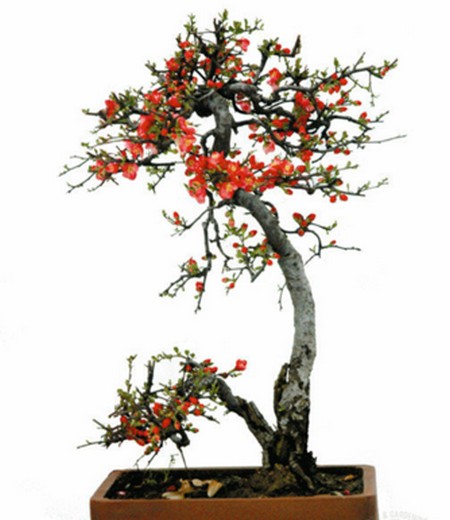
After planting Malus spectabilis seedlings, care and management should be strengthened, and the soil should be kept loose and fertile at all times. Each autumn and winter, a batch of pond mud or fertile soil can be replaced around the root zone. After leaf fall and before bud break in early spring, carry out one pruning, cutting out dead and weak branches and diseased and pest-infested branches, to keep the canopy open and well ventilated and lit. To promote vigorous flowering, water sprouts should be cut back to reduce nutrient consumption during sprouting, so that all retained axillary buds can obtain more nutrients and form more flowering and fruiting branches. Fruiting branches and intermediate branches do not need pruning. During the growing season, if pinching is done in time to restrict vegetative growth early, the effect will be even more pronounced. For potted stump bonsai, this control should be applied even more.
For stump bonsai in containers, use old wild tree stumps collected before bud break in spring. For some species with deep, long main roots, the overly long main roots should be cut off promptly after digging. The stump must keep its native soil to protect the roots and retain moisture; if transported over long distances, special attention must be paid to keeping the roots moist to prevent the fibrous roots from losing water and thus affecting survival. After 1-2 years of root and trunk development, once the stump has taken preliminary shape, it can be potted before Qingming. For cultivating stump bonsai, shallow pots should be chosen. At the initial planting, more soil should be mounded over the roots, and later the roots can be gradually raised; combined with fist-sized stones, this creates a Malus spectabilis stump bonsai with a wild mountain-forest charm.
Newly potted stump bonsai should be shaded for a period before returning to normal management. To make the stump bonsai bloom profusely and bear many fruits, water and fertilizer management should be strengthened. Before flowering, apply 1-2 topdressings of a mixed phosphorus and nitrogen fertilizer; after flowering, apply a dilute phosphorus-potassium fertilizer once every half month to promote plump fruit and reduce fruit drop.
For shaping and training Malus spectabilis, a combination of wiring and pruning is often used, and the processing period is best from after leaf fall in winter to before bud break in spring. During the plum rain period, new branches have grown relatively mature and the branches are more flexible, so it is also suitable for pruning and wiring. Seedlings 2-3 years old can begin processing; at this time plasticity is great and operation is relatively easy. It is best to use both palm fiber and metal wire; the trunk and large branches need appropriate wiring, while all small branches are shaped entirely by pruning. Branches and leaves should be pruned into a natural canopy shape; it should not be wired into an overly regular form.
Malus spectabilis grows relatively fast, so palm fiber and metal wire should be removed in time to prevent harm to the tree. It can be processed into many styles, such as slanting trunk, curved trunk, waterside, cascade, double trunk, and multiple trunk. Malus spectabilis has strong sprouting ability and grows fast. Attention must be paid to shaping and pruning. From after leaf fall in winter to before bud break in spring, miscellaneous branches such as dead branches, diseased and pest-infested branches, thin and weak branches, crossing branches, overlapping branches, and overly dense branches can be cut out. After flowering in spring, according to shaping needs, overly long branches can be appropriately shortened to promote side branching, increase the number of flower buds, and ensure abundant flowering the following year. In addition, after bud break in spring, excessive, overly dense, and poorly positioned buds can be removed.
For Malus spectabilis, which flowers once every spring, methods such as lowering temperature, reducing water, and shading light can make it bloom again in the same year's autumn. Specific method: in early July, move the potted Malus spectabilis tree to a rain-sheltered, cool place to lower the temperature, reduce light, and control watering. Watering must be gradually reduced, reduced until the plant's leaves turn yellow and fall off on their own, so as to induce dormancy. After that, continue watering a small amount, just enough to maintain life and prevent new buds from sprouting. After 35-45 days of dormancy in this way, place the plant under full light, water thoroughly, and apply liquid fertilizer to awaken it and make it sprout new buds (leaf buds and flower buds grow together). After another 5-7 days, brilliant and eye-catching Malus spectabilis flowers can be seen.
In addition, taking advantage of its bud scales' sensitivity to temperature, a heating method can be used in deep winter to force flowering: move the potted Malus spectabilis stump bonsai into a sunny spot in a greenhouse, water thoroughly, apply liquid fertilizer, and thereafter spray water appropriately on the branches and trunk every day, keeping the room temperature at 20-25°C. After 30-40 days, it can also bloom, and can be used for display and viewing at New Year's Day or Spring Festival. Large cut branches grown in water can also be forced in a greenhouse. They can be grown in water in batches throughout the winter and used as they bloom.