Detailed Guide to Making a Malus halliana Bonsai
Malus halliana has brilliantly colored flowers and graceful blossoms, blooming after plum blossoms. Its red and pink flowers are lush and beautiful, especially the deep red buds just about to open, hanging on thread-like pedicels and swaying in the wind, elegant and charming. The petals are rose red, each delicate and vividly colored, making it a beloved woody flowering plant for courtyards.
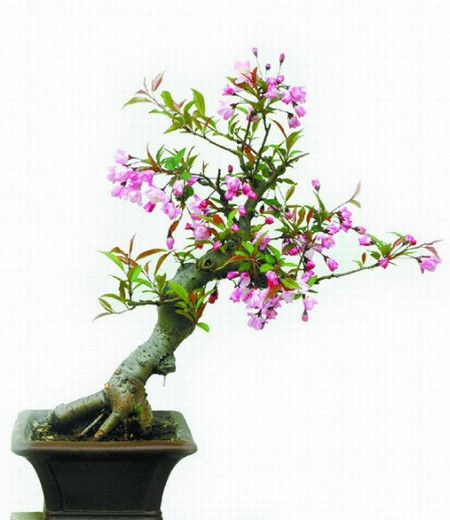
Malus halliana has a graceful tree form, with its peak blooming period from March to April, when red flowers cover the branches, draping and drooping gracefully - this is the best viewing period. For potted plants, measures such as heating in winter can be used to make them bloom earlier.
[Production Process]
Malus halliana bonsai is mainly grown for its flowers, blooming once a year from March to April. If management measures such as cooling, reducing water, and shading are taken, it can be made to bloom a second time in autumn of the same year. The method is:
In early July, move the potted crabapple to a cool place, carry out treatments such as cooling, reducing light, and controlling watering, prompting its leaves to turn yellow and fall off on their own, entering a dormant state. Then water sparingly to sustain life. After more than a month of dormancy, move the plant to a place with ample light, water thoroughly and apply liquid fertilizer, so that it revives and sprouts new buds, and after another 5 to 7 days it can bloom again.
[Potting Process]
Pot selection: For Malus halliana, use medium-deep round, rectangular, or square pots, preferably made of purple clay pottery or glazed pottery. The color and shape of the pot must harmonize with the tree form and flower color of the crabapple.
Soil: Crabapples prefer fertile soil, so use fertile, loose leaf mold or garden soil, mixed with an appropriate amount of sandy soil and rice husk ash. They can grow in slightly acidic or slightly alkaline soil.
Planting: Best done in early spring, though late autumn is also acceptable. When potting, place decomposed soybean cake and bone meal at the bottom of the pot as base fertilizer.
[Shaping Techniques]
Training: Malus halliana is best shaped using palm fiber binding combined with pruning. However, care must be taken to remove the palm fiber in time, otherwise it easily causes "wire bite" (bark embedding), affecting both appearance and tree growth. Training is best done during the dormant period, or after flowering.
Tree form: Malus halliana bonsai is best styled as slanting trunk, curved trunk, or cascade styles. Branches should be upright, elegant, and spreading, with attention to appropriate spacing so that flowering branches are lush, flower colors are vivid, and the ornamental effect is enhanced.