A detailed guide to making vegetable bonsai: almost any vegetable can be used
Potted vegetables have strong ornamental and practical value, and can be used as miniature bonsai to decorate a room, courtyard, or balcony. Potted vegetables are easy to source, easy to grow, and easy to keep alive. They are generally grown from seeds, root tubers, tubers, or fresh stems, are not limited by region or season, and can be planted again and again with fresh results. Vegetable varieties commonly used for indoor cultivation include: cherry tomato, five-color pepper, miniature eggplant, small cucumber, colorful leaf lettuce, naranjilla, flying saucer squash, small cucumber, no-stake snap bean, seven-color spinach, sprouts, and so on.
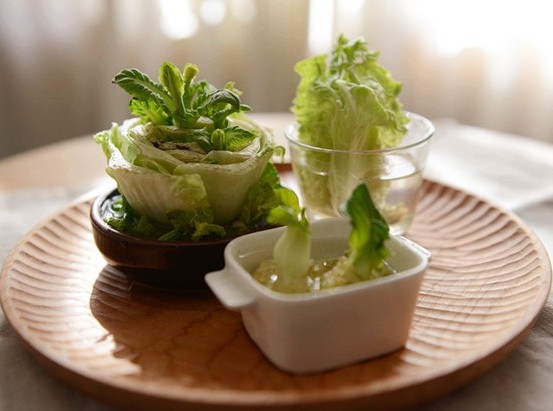
[Clever Ways to Make Vegetable Bonsai]
At the end of winter and the beginning of spring, make a few pots of vegetable bonsai yourself. Place them on a desk or hang them in front of a window to add greenery to a room early and enjoy the pleasure of doing it yourself.
Onion Narcissus:
Place the onion in a porcelain pot, weigh it down with small pebbles, add clean water, and change the water every 3 to 5 days. After two weeks, lush new leaves will grow, looking very much like a narcissus.
Ginger Green Bamboo:
Take several pieces of fresh ginger, place them bud-end up in a shallow pot, then cover with 1 cm of fine soil. After watering thoroughly, place it on a sunny windowsill. Before long, the fresh ginger will sprout tender buds and gradually put out green leaves, just like a clump of green bamboo.
Carrot Cedar:
When preparing vegetables, people often toss out a few slightly scarred tops. You can retrieve them, wash them clean, cut the bottoms flat, put them in a narcissus pot, and fill it halfway with clean water. After three to five days, fine green leaves will grow from the carrot tops. With a little sunlight, they can grow very vigorously. When the carrot greens emerge, they are so fresh and green they seem to drip, and they resemble a cedar.
Radish Flower Basket:
Hollow out the bottom of a fairly large radish to make it cup-shaped, then stuff in a ball of cotton, evenly sprinkle a layer of wheat seeds on top, sprinkle on some water, and hang it in front of a sunny window. After a week, the wheat seeds become green wheat sprouts, and the radish also grows tender green leaves, shaped like a flower basket.
Celery Putting Out Hearts:
Cut off the base section of celery (about 7 cm long, with the root fibers left on) with a knife, place it in a mineral water bottle of equal height (that is, a section cut from the bottom of a mineral water bottle), and add water so that it covers the root fibers. After 3-5 days, the new hearts of the celery will cluster and push out.
Jade Garlic Sprouting Green:
When the weather turns warm, garlic heads will sprout. Peel off the outer skin, separate into individual garlic cloves, string them into a string, and finally form a ring so it can sit steadily in a narcissus pot. The wire must not pass through the very center of the garlic cloves; it should be slightly to the side so as not to damage the sprout tips. Add water, give it sunlight, and green leaves will grow out. Garlic leaves look like narcissus leaves, but they will not bloom. Still, watching that pot of lush green is a joy in itself.
Chive Bonsai:
Its method of making is the same as for garlic bonsai. It is very elegant; chive leaves stay evergreen, have a rich green color, and are attractive and appealing.
Cultivation Notes:
① According to the cultivation characteristics of different vegetable varieties, choose the correct cropping slot, suitable seedling-raising period, and planting and selling period.
② According to the fertilizer requirements of different vegetables, mix nutrient soil (solution) in proportion. Fertilizer should mainly be pollution-free organic fertilizer, and chemical fertilizers should be used as little as possible, especially nitrogen chemical fertilizers. Where conditions permit, tissue-culture seedlings and soilless cultivation can be used.
③ Dwarf varieties should be selected. Since there are currently not many dwarf varieties, plant growth regulators can be used to control plant growth, which is good both for ornament and for manual management.
④ The cultivation of ornamental vegetables must conform to people's aesthetic taste. Pruning, trellising, shaping, and landscaping should be carried out according to different vegetable varieties and market demand. Several plants of the same variety can be combined, or different varieties can be combined for landscaping.
⑤ Potted miniature ornamental vegetables must be pollution-free vegetables, and their pests and diseases should be controlled with pollution-free prevention and control techniques. In principle, agricultural control and biological control should be primary, and chemical control supplementary.