Detailed Explanation of the Method for Creating Exposed-Root Stump Bonsai
Roots are an important part of stump bonsai, and the distribution and shape of the roots directly affect the ornamental value of the bonsai.
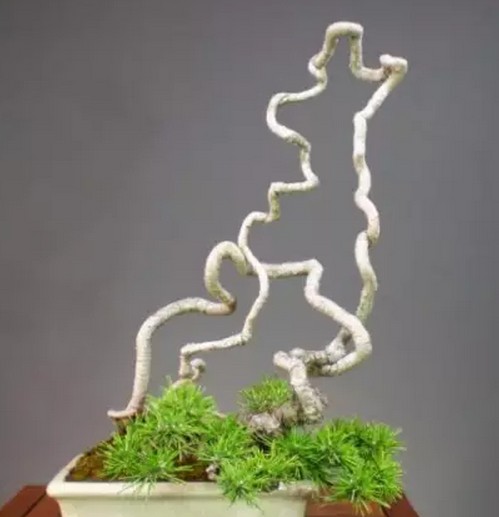
Through planned cultivation of the stump's roots, repotting, changing the soil, and changing the pot year by year, the roots are arranged during this process, the direction of root extension is controlled, and planting continues, gradually exposing the roots above the soil surface. The commonly used root-exposing methods include the following:
(1) Deep-pot high-planting mounding method. Use a deep, wide cultivation pot filled with loose, fertile, well-drained soil. The soil in the pot can be shaped above the pot rim, and the stump is planted in the soil above the pot surface. After several years of cultivation, the root system grows thicker and longer, the soil on the pot surface gradually decreases, and the roots slowly become exposed.
(2) Shallow-pot sleeve-tube soil-filling method. Use a shallow, wide cultivation pot, fill it level with soil suitable for growing trees, and fit a cylinder one-third smaller than the pot opening over the pot surface. The cylinder can be made from multiple layers of plastic film, or from tar paper or thin wooden boards, then loose, fertile soil is added into the cylinder, and the stump is planted inside the sleeve tube. After several years of cultivation, the roots extend to the bottom of the pot and thicken appropriately. When they can support the stump, the sleeve tube can be removed to expose the roots. Tree species that easily grow aerial roots, such as the banyan tree (Ficus), are commonly root-trained by this method.
(3) Stump root-cutting cultivation. Use stumps with exposed roots dug from the mountains or purchased from the market, and cut off their main roots and lateral roots (the cut surfaces should face downward). Through cultivation, fine roots grow from the cut openings, so that no saw-cut scars are visible, the root shape is attractive, and the time needed for root training can also be shortened
(4) Clasping-root root-exposing method. This method is mostly used for Norfolk Island pine (Araucaria heterophylla) bonsai. Plant a small Norfolk Island pine seedling in a small pot, and its roots naturally extend in circles along the pot rim. When the seedling grows vigorously, the root system clasps into a fist-like mass, and then the roots are raised and planted to form the final shape.
(5) Stone-attached cultivation. According to the requirements for exposed roots, when the tree roots have been grown to a certain length, choose sand-stalactite stone, Yingde stone, sea-mother stone, or similar stones that are attractive in shape and have vertical holes or crevices, with the length of the stone matching the length of the tree roots. Then thread the tree roots through the holes and wedge them into the crevices to clasp the stone tightly, bind them with palm fiber or plastic strips so that the roots cling closely to the stone body, wrap a sleeve tube around the outer perimeter of the stone, and fill the tube with soil. After the stump has been cultivated for 2^-3 years, the sleeve tube is gradually lowered until it is completely removed, forming a natural stone-attached exposed-root bonsai.
The root-exposing methods mainly include three types: the deep-pot high-planting mounding root-exposing method, the deep-pot level-planting water-flushing root-exposing method, and the cylinder sand-cultivation root-exposing method.
In the deep-pot high-planting mounding root-exposing method, after the stump is planted in a deep pot, it takes 2-3 years, combined with repotting, to raise the roots upward year by year before the tree roots can be exposed. In the deep-pot level-planting water-flushing root-exposing method, each time you water, raise the watering can so that the water flushes against the roots, gradually washing away the soil around the roots and exposing them. Then, combined with repotting, raise the planting position of the roots so that the exposed portion of the roots gradually increases and the shape gradually becomes more perfect. In the cylinder sand-cultivation root-exposing method, after the roots have grown well, remove the stump from the cylinder and plant it in a shallow pot. When planting, carry out appropriate trimming and shaping so that the roots are exposed on the pot surface.
Create an environment that allows the roots to take shape, such as a tall cylinder environment. The soil in the cylinder must be breathable; coarse sand can be chosen as the soil, and for a more refined approach, use large-particle perlite, vermiculite, and small-particle orchid stone, all of which are very breathable.